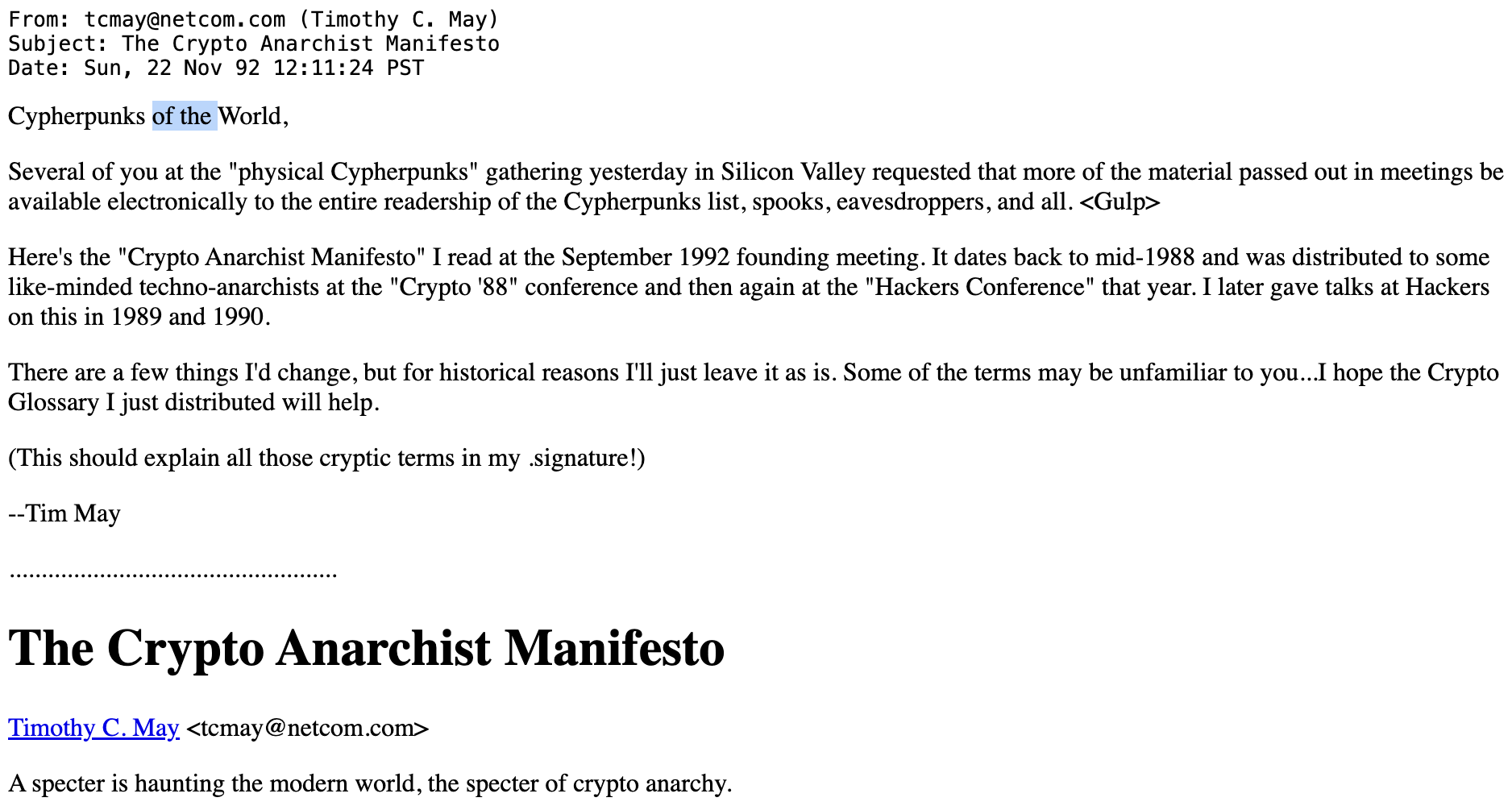
A specter is haunting the modern world, the specter of crypto anarchy. So opens the 497-word essay Timothy C. May read aloud at the founding meeting of the Cypherpunks in September 1992, and posted to the newly created cypherpunks mailing list on November 22 of the same year. The opening is a direct play on the Communist Manifesto. The closing line — arise, you have nothing to lose but your barbed wire fences — is another. The whole essay is structured as a Marx parody whose joke is that the technology of liberation has changed.
May, then a recently retired Intel senior scientist living in the hills above Santa Cruz, did not write the manifesto in 1992. He wrote it in mid-1988 and distributed mimeographed copies at the Crypto 88 academic conference and the Hackers Conference of the same year. He gave talks on it at Hackers in 1989 and 1990. For four years it circulated as samizdat among a small group of techno-libertarians and cryptographers who recognized that something new was being described. The 1992 publication to the cypherpunks list is the moment the document became public.
The manifesto predicts, with unsettling accuracy, most of what would matter. Untraceable communication via re-routed encrypted packets. Anonymous markets. Digital reputations divorced from legal identity. Electronic contracts negotiated between parties who never know each other True Names. Tamper-proof boxes implementing cryptographic protocols. The phrase the catalog later adopts as the artifact at the heart of bitcoin culture — sound money outside the state — is not in the text, but the conditions for it are. May understood that anonymous digital cash was the keystone, and that anonymous digital cash required public-key cryptography, and that public-key cryptography existed.
What the manifesto did not predict was the form. May imagined crypto anarchy as a constellation of private services run by reputation-bearing pseudonyms over BBSes and remailer networks. He did not imagine a single global ledger maintained by a network of competing miners running open-source software. Bitcoin is not what crypto anarchy looked like in 1988. It is what crypto anarchy turned out to be possible to build.
The manifesto is short. Four hundred ninety-seven words. May reportedly wrote it on a Macintosh Plus. It contains no math, no code, no implementation. It is a description of a future that the author believed was inevitable, written in the present tense, in the voice of a man who had already chosen which side he was on. The cypherpunks mailing list, which May co-founded with Eric Hughes and John Gilmore that same September, would over the next decade become the channel through which the technical work of building that future actually happened. Hashcash. b-money. Bit Gold. Reusable Proof of Work. Bitcoin.
The manifesto is the parent document of bitcoin in a way the whitepaper is not. The whitepaper describes how. The manifesto describes why.