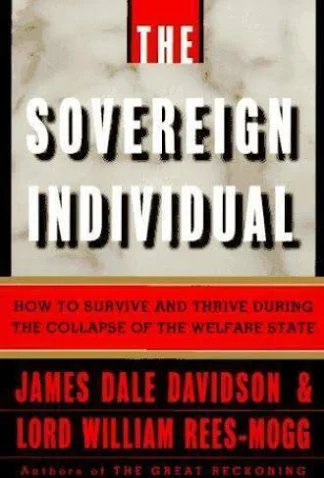
The Sovereign Individual: How to Survive and Thrive During the Collapse of the Welfare State was published in 1997, twelve years before the bitcoin whitepaper, by an American investment writer named James Dale Davidson and a British newspaper editor named William Rees-Mogg. It was their third collaboration. The previous two had predicted the collapse of the Soviet Union and the long bond rally of the 1990s with sufficient accuracy to give the authors some claim to a track record. The Sovereign Individual was a more ambitious project — a four-hundred-page argument that the printing press, the gunpowder revolution, and the steam engine had each produced a corresponding civilizational reorganization, and that information technology was about to produce another.
The book’s central prediction, the one bitcoiners now cite, occupies a relatively small fraction of its pages. Davidson and Rees-Mogg argued that the rise of strong cryptography, combined with the borderless jurisdiction of cyberspace, would produce a new kind of money — cybermoney, in their phrase — that nation-states would be unable to tax, debase, or seize. The state had financed itself for five centuries by maintaining a monopoly on the issuance of currency and the assessment of income. Both monopolies, the authors argued, were about to fail. Income would be earned in jurisdictions a tax authority could not identify. Wealth would be held in instruments a tax authority could not confiscate. The result, they claimed, would be a structural shift in the relationship between the individual and the state, comparable in scope to the shift the printing press had produced between the layperson and the church.
The book is, by most measures, a strange artifact. It is libertarian in disposition but not in argument; the authors do not particularly approve of what they predict, only insist that it is coming. It is, in places, alarming — they imagine governments turning nasty, in their word, as their tax base evaporates, and predict an erosion of the social compact that they treat as inevitable rather than tragic. The book has been criticized as a manual for an exit class, a celebration of the secession of the wealthy from the political community. The criticism is fair. It has also been criticized as a series of predictions that did not all come true; the case for a cognitive elite untethered from nation-state allegiance has, in 2025, a more complicated record than the book’s confident 1997 voice would suggest.
What the book did get right — uncannily, in retrospect — was the cybermoney prediction. Davidson and Rees-Mogg described, in 1997, a digital currency secured by cryptographic algorithms, issued without state involvement, transferable across borders without permission, and held in forms that no government could effectively seize. Bitcoin’s emergence in 2009 mapped onto the prediction with a precision that has, in the bitcoin community, given the book a kind of prophetic standing. Saifedean Ammous would call the prediction remarkable in The Bitcoin Standard. Naval Ravikant, Brian Armstrong, and Peter Thiel would publicly recommend the book to bitcoiners; Thiel would write a foreword for the 2020 reprint. The book is, for many bitcoiners, the document that explains why bitcoin matters in a way the whitepaper itself, with its narrow focus on the double-spending problem, declines to.
The honest read is that bitcoin culture has adopted The Sovereign Individual as its philosophical text the way the cypherpunks adopted Eric Hughes’s Manifesto as its founding charter. The book’s specific predictions are mixed; its central thesis — that a new monetary technology would alter the balance of power between individuals and states — has been treated by many bitcoiners as already vindicated. Whether the vindication is real or premature is a question the catalog declines to settle. What the catalog records is that the book exists, that bitcoiners read it, and that it remains in print twenty-eight years later because a generation of readers came to it through a protocol its authors did not live to see.