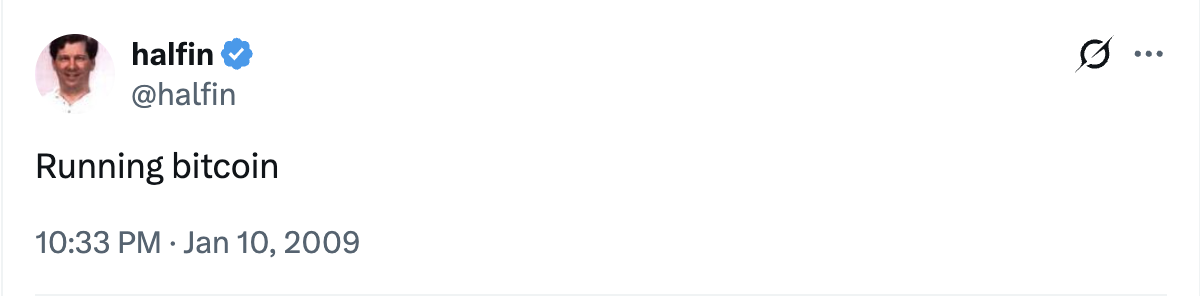
On January 11, 2009 — a Sunday, eight days after the genesis block — Hal Finney posted two words to Twitter: Running bitcoin. He had been on the platform for less than a year. The post had no link, no context, no thread. Most of his followers, if he had any, would have had no idea what bitcoin was.
The tweet has since accumulated tens of thousands of likes and retweets. It is, by a comfortable margin, the most quoted post in the cultural history of the asset. It works because it is plain. A man at a keyboard. A piece of software. A two-word status update, the same kind anyone might write about a marathon or a load of laundry. The understatement is the entire artifact.
Harold Thomas Finney II was, by January 2009, already one of the most accomplished cryptographers of his generation. Born in Coalinga, California in 1956 and educated at Caltech, he had written video games for the Atari 2600, contributed to the development of PGP encryption, and in 2004 created Reusable Proof-of-Work — a direct intellectual predecessor to bitcoin’s mining mechanism. When Satoshi posted the whitepaper to the cryptography mailing list on October 31, 2008, Finney was the first person to respond constructively. On January 12, the day after the tweet, Satoshi sent him ten bitcoin. It was the first peer-to-peer bitcoin transaction in history.
In August of that same year, Finney was diagnosed with ALS. He continued to write, code, and post. In March 2013, by then almost completely paralyzed, he composed a long essay on the BitcoinTalk forums titled Bitcoin and me, recounting his early involvement and his current situation with characteristic plainness. He died on August 28, 2014, in Phoenix. His body was cryopreserved by the Alcor Life Extension Foundation, in accordance with his wishes.
A note on geography, since it has been the subject of speculation. Hal Finney lived in Temple City, California — a small suburb east of Los Angeles. So did a man named Dorian Nakamoto, whom Newsweek would later misidentify as Satoshi. The coincidence is real and unsettling. Finney was not Satoshi. The most thorough debunking comes from public records showing Finney was running a competitive ten-mile race during one of the documented Satoshi email exchanges. The two-word tweet remains his.
In a coincidence no one could have arranged, the United States Securities and Exchange Commission approved the first spot bitcoin exchange-traded funds on January 11, 2024 — exactly fifteen years after Finney sat down at his keyboard, opened his bitcoin client, and described what he was doing.