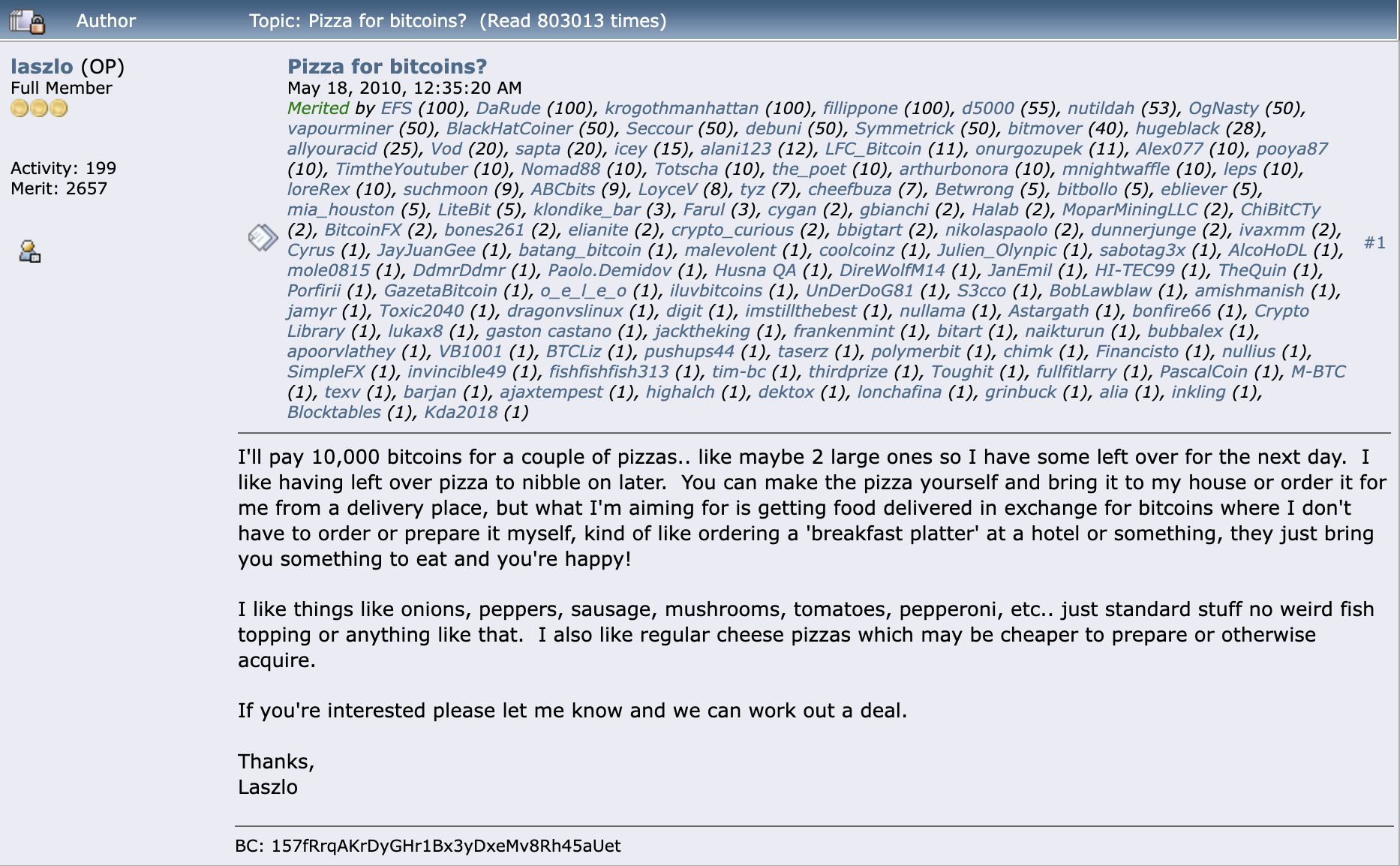
The transaction itself happened on May 22, 2010, in Jacksonville, Florida. A programmer named Laszlo Hanyecz, who had been mining bitcoin on his home laptop and accumulating tens of thousands of coins, posted to the BitcoinTalk forums offering ten thousand bitcoin to anyone who would order him two pizzas. A British teenager named Jeremy Sturdivant — username jercos — took the deal, called Papa John’s, paid in dollars, and had the pizzas delivered. Hanyecz sent the bitcoin. The transaction is widely cited as the first time bitcoin was exchanged for a physical good. It has its own catalog entry. This one is about what happened after.
For the first three years, the anniversary passed largely unobserved. The bitcoin community in 2010 and 2011 was small enough to fit on a single forum thread; the cultural infrastructure to declare a holiday did not yet exist. The shift came in 2013 and 2014, as the asset moved from cypherpunk curiosity into something resembling public consciousness. The New York Times ran a piece on Hanyecz’s transaction in early 2014. The @Bitcoin Twitter account began marking the date. By the May 22, 2014 anniversary, the phrase Bitcoin Pizza Day had taken hold as the canonical name. Forum posts that year began pricing the meal in then-current dollars — a tradition that would become the holiday’s defining ritual.
The math is the point. On May 22, 2010, ten thousand bitcoin was worth approximately forty-one dollars. On May 22, 2014, it was worth roughly $5.2 million. By the holiday’s tenth anniversary in 2020, $90 million. By its fifteenth, in 2025, well over a billion. The pizzas, calculated at any plausible price, become the most expensive lunch in recorded human history, by orders of magnitude, and the gap widens every year. The annual recalculation is the joke. The annual recalculation is also, quietly, a meditation on the asset itself.
Hanyecz has been remarkably gracious about it. In a 2019 interview with Anderson Cooper for 60 Minutes, asked whether he regretted the trade, he said it had made bitcoin real for some people, including himself. He has continued to participate in the holiday, including a follow-up Lightning Network pizza purchase in 2018 to demonstrate the protocol’s viability for small payments. Sturdivant, the British teenager who took the order, spent the bitcoin on travel within weeks. Neither of them, by their own accounts, lies awake at night.
The holiday is now observed globally. Binance has run Pizza Day promotions in sixteen countries. Bitcoin Magazine organized a 2025 celebration in Uganda that fed 115 orphans. Independent bitcoiners host meetups, post photos of their pizzas, and share the running tally of what Laszlo’s lunch would be worth today. There is no central organizing body. There is no official date approval. May 22 is simply when bitcoiners eat pizza, recalculate the math, and remember that money is a story people tell each other, and that sometimes the story changes.