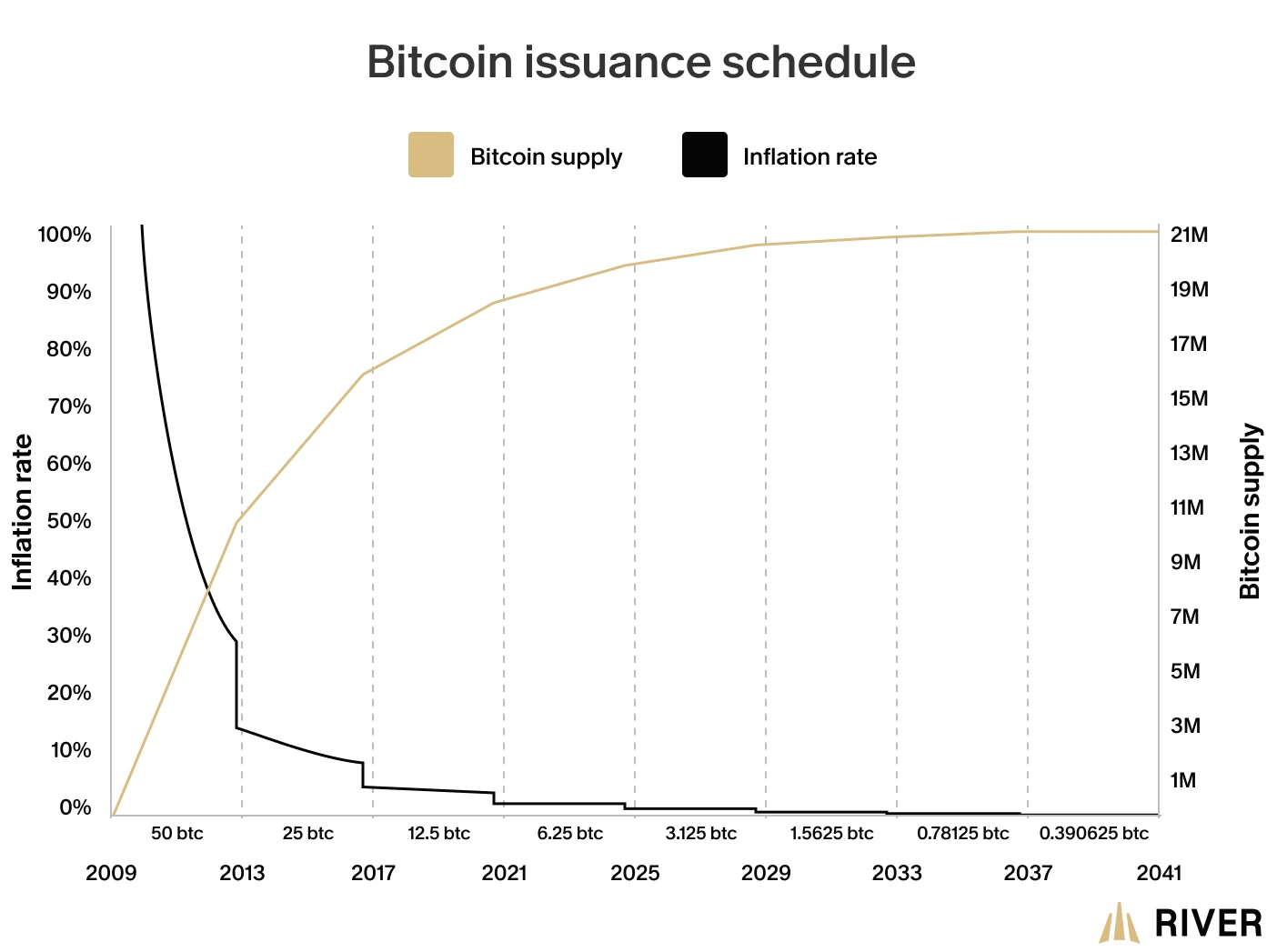
The bitcoin protocol’s monetary policy is encoded in approximately ten lines of C++ code. Every 210,000 blocks — roughly every four years, given the protocol’s ten-minute average block time — the reward paid to miners for producing a new block is cut in half. The schedule was set by Satoshi Nakamoto in 2009 and has never been altered. The first halving occurred on November 28, 2012, reducing the block reward from fifty bitcoin to twenty-five. The second occurred on July 9, 2016, reducing it to twelve and a half. The third occurred on May 11, 2020, reducing it to six and a quarter. The fourth occurred on April 19, 2024, reducing it to three and one eighth. The schedule will continue, halving by halving, until approximately the year 2140, when the final fraction of a bitcoin is mined and the block reward becomes zero. There will be, at that point, approximately 21 million bitcoin in existence. There will not be more.
The first halving in November 2012 passed largely unobserved. The bitcoin community at the time was perhaps a few tens of thousands of people, the price was around twelve dollars, and the event registered as a technical curiosity rather than a cultural one. The second halving in July 2016 was different. The community had grown by an order of magnitude. The Block Size Wars had created a kind of religious sensibility about the protocol’s properties. The supply schedule, which had previously been an implementation detail, became understood — particularly within the maxi-aligned wing of the community — as one of the asset’s defining features. The halving became, for the first time, a holiday.
The cultural form was loose but consistent. Bitcoin Twitter began counting down the blocks in the weeks before the event. YouTube channels broadcast live as the halving block approached, with the announcer reading out the block height in the same cadence one might read a New Year’s Eve countdown. Conferences scheduled events around the date. Memes proliferated, mostly involving timepieces, hourglasses, and the phrase tick tock next block. Hardware wallet manufacturers ran sales. Bitcoin Magazine published commemorative issues. The halving’s meaning — that bitcoin’s supply schedule was real, immutable, and was now publicly executing its next predetermined step in front of an audience of millions — was, in the bitcoin community’s framing, the entire point of the celebration.
The price effects of halvings have been the subject of considerable analysis and somewhat less consensus. Each of the first three halvings was followed, within twelve to eighteen months, by a substantial bull market. The pattern is consistent enough that a popular Stock-to-Flow model, published by an analyst writing under the pseudonym PlanB in 2019, used it as the basis for price predictions that subsequently proved to be either roughly correct or substantially wrong, depending on which forecast horizon one consults. Whether the halving causes the bull markets, or whether the four-year cycle is a coincidence of macroeconomic timing, or whether the entire pattern is now too widely anticipated to repeat, is a question that the bitcoin community will continue to argue about until at least the 2028 halving, by which time the next round of evidence will be available.
The cultural significance is independent of the price action. The halving is the bitcoin protocol’s only recurring public event. The blockchain’s other milestones — the genesis block, the Pizza Day transaction, the Mt. Gox collapse — happened once. The halving happens every four years, on a schedule established before the asset’s first user existed, and will continue happening for another century after every reader of this entry is dead. It is, in the bitcoin community’s usage, the closest thing the asset has to a calendar. The Christian liturgical year tracks the resurrection. The bitcoin year tracks the issuance schedule. Both are, in their respective communities, a way of organizing time around something that does not change.