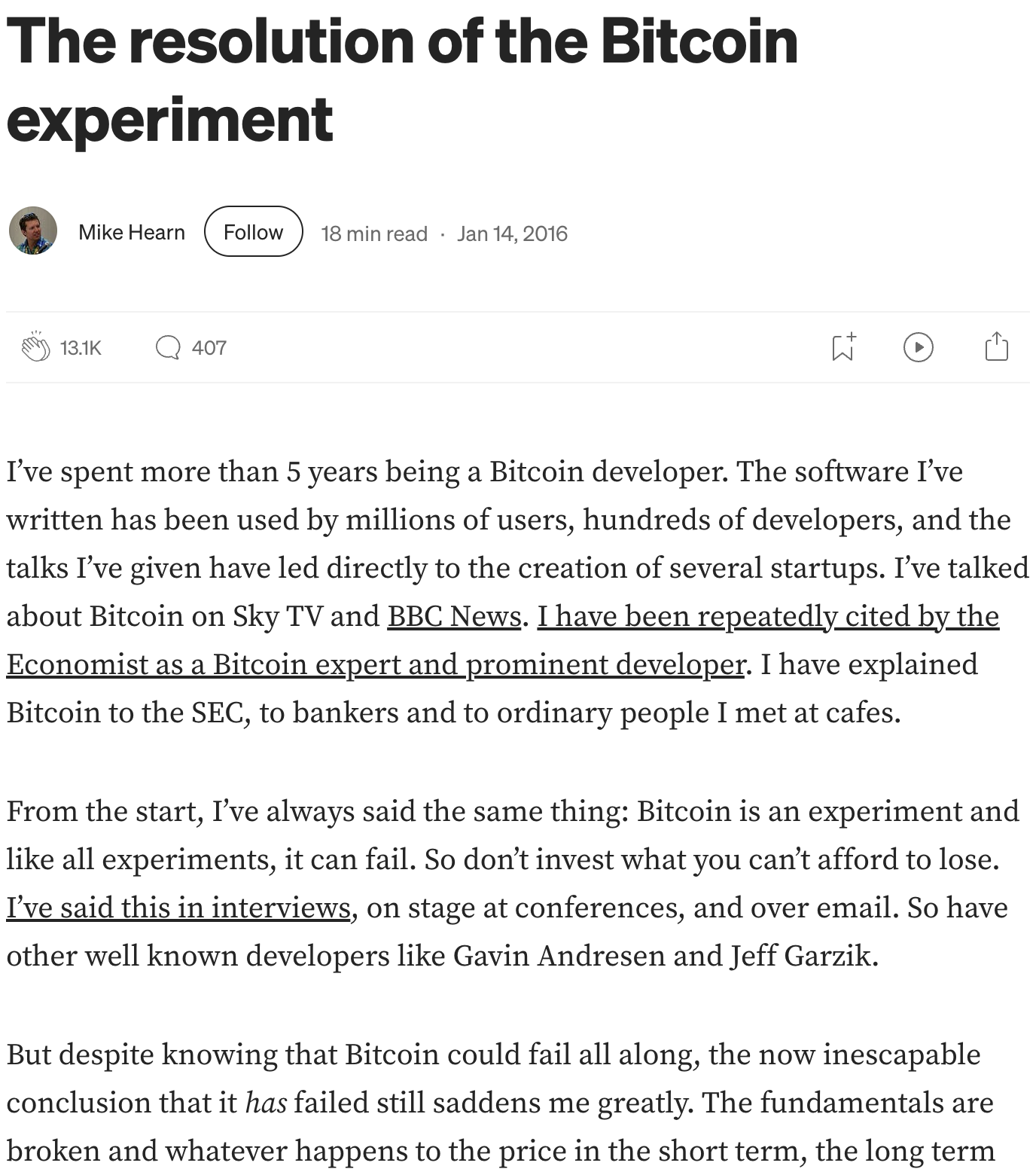
In January 2016, a Bitcoin Core developer named Mike Hearn published a blog post titled The resolution of the Bitcoin experiment. The post was three thousand words long. It opened with a declaration: bitcoin had failed. Hearn explained why he believed this, what he thought had gone wrong, and announced two consequential personal decisions. He was leaving bitcoin development. And he had sold all of his coins.
Hearns credibility was substantial. He was a senior software engineer who had spent eight years at Google before joining bitcoin development full-time. He had corresponded with Satoshi by email in 2010 and 2011, and was the recipient of the April 23, 2011 message in which Satoshi announced his departure. He had built bitcoinj, the Java implementation of the protocol used by every Android wallet of the era. He had written reams of bitcoin documentation, given talks at conferences, and was one of perhaps two dozen people in the world who could plausibly claim to be a senior bitcoin engineer. When Mike Hearn said bitcoin had failed, the bitcoin community had to take it seriously. The mainstream press took it more than seriously. Within hours of publication, Fusion, Wired, Business Insider, and the New York Times had run obituaries.
The argument of the essay, in summary, was this. Bitcoin was supposed to be a decentralized payment system, but governance had been captured by a small group of developers led by what would become Bitcoin Core, and these developers had refused to raise the one-megabyte block size limit despite obvious capacity pressure. The blockchain was full. Transaction fees were spiking. Confirmation times were lengthening. The mechanisms that should have prevented capture had not worked. And the politics inside the developer community had become so toxic that productive work was no longer possible. The system was, in Hearns view, on the brink of technical collapse and in the hands of people unwilling to fix it.
Bitcoins price the day Hearn published was around four hundred dollars. Hearn estimated the long-term trend was downward. He acknowledged he could be wrong, but said the fundamentals looked broken enough that he had decided to liquidate.
The essay was, in the technical analysis, partly correct. The block size debate was a real and consequential disagreement. The 2016-2017 period was a genuinely difficult one for bitcoin, with rising fees and slow confirmations and an increasingly fractious developer community. Hearns specific complaints about governance and capacity pressure were not invented. They described the situation he saw with reasonable accuracy.
The essay was, in the conclusion, completely wrong. Bitcoin did not collapse. The block size debate was resolved through SegWit activation in August 2017 — itself a contested compromise — and through the Bitcoin Cash fork that let the big-block faction leave with a portion of the community. Lightning Network development picked up in 2017 and 2018. The price did not trend downward; it rose to twenty thousand dollars in 2017, fell, recovered, and by 2026 had crossed multiple orders of magnitude beyond where Hearn had sold. The community he described as broken continued to ship working software for the next decade.
Hearn published a follow-up in 2021 acknowledging that he stood by his analysis and had not been convinced he was wrong. By then bitcoin was at sixty thousand dollars and his original essay had become one of the most-cited capitulation documents in bitcoin history — preserved, screenshotted, mocked, used as the canonical example of why insiders calling time on bitcoin should be ignored. Bitcoin Obituaries, the catalogs entry on the four-hundred-plus instances of journalists and analysts declaring bitcoin dead, treats Hearn as a special case: not because he was the loudest, but because he came from inside. His was the most credible obituary anyone wrote, written at the moment when the case was strongest, by the person most positioned to know.
The artifact is the essay and what happened next. The catalog records it because it is impossible to understand bitcoin culture in 2026 without understanding that in January 2016 a senior insider, in print, declared the project dead, and that he was so confidently wrong that the essay has become a piece of evidence for the protocols durability. Bitcoin survived its creators departure. It also survived being publicly buried by one of its most experienced engineers.
Hearn moved on to corporate blockchain work — R3, then various consulting roles — and has not returned to bitcoin development. The coins he sold at four hundred dollars would be worth several hundred million today.