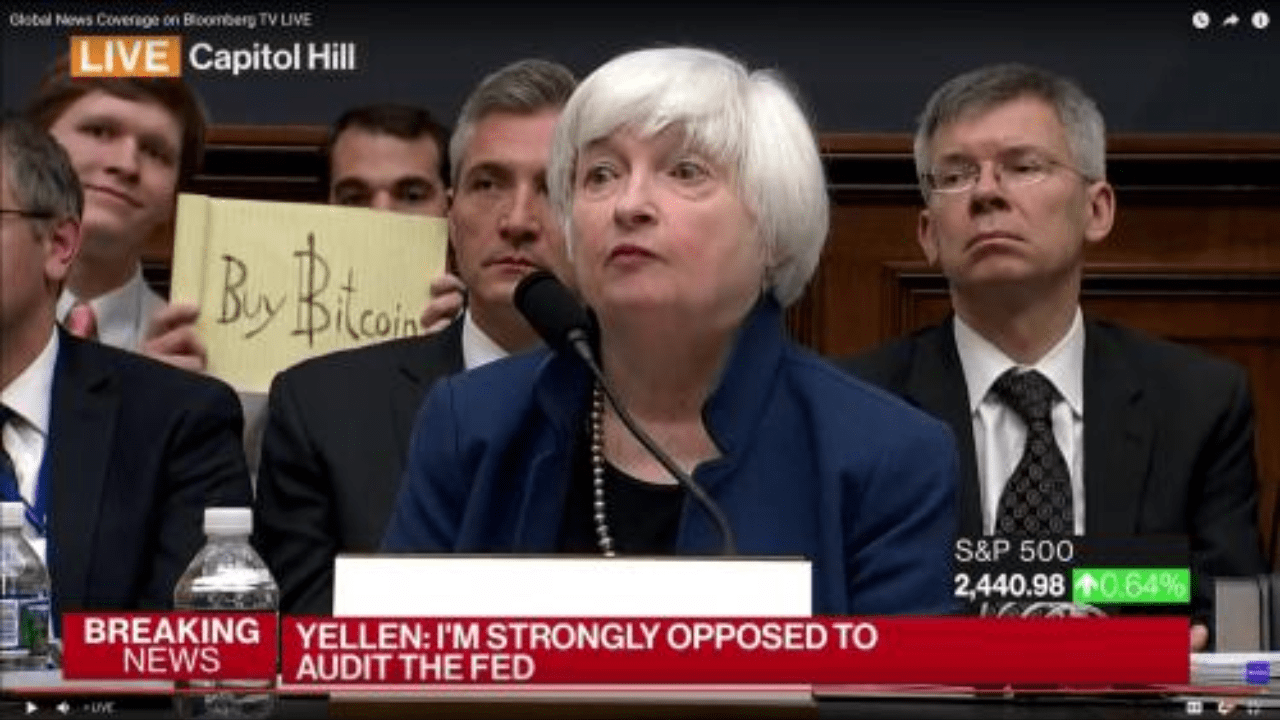
On the morning of July 12, 2017, a 22-year-old summer intern at the libertarian Cato Institute named Christian Langalis arrived early enough at a House Financial Services Committee hearing to claim a seat in the second row, directly behind the witness table. Janet Yellen, then chair of the Federal Reserve, was scheduled to deliver semiannual monetary-policy testimony. The hearing would be televised.
Langalis had brought a yellow legal pad and a Uniball Vision fine-point pen. At some point before Yellen began speaking, he tore off a sheet, wrote Buy Bitcoin on it in block letters — substituting a stylized ₿ for the B — and held it up to the camera over Yellen’s left shoulder.
He held it up for several minutes. C-SPAN broadcast it. The clip was already circulating before Yellen had finished her testimony. Langalis did not know this; his phone had died waiting for the hearing to start, and he was escorted out of the chamber shortly after the sign appeared, for violating committee rules against displaying signage. Bitcoin’s price closed roughly four percent higher that day, at approximately $2,300.
Why the image worked
The image is, in a literal sense, two things at once: an institutional setting and a homemade one. Yellen, the chair of the Federal Reserve, is delivering prepared remarks under the Great Seal of the United States. Behind her, a kid with a legal pad has written two words with a pen. The composition is part of the meme.
Bitcoin’s culture, in 2017, was largely libertarian and largely contemptuous of central banking. The image staged that opposition with unusual economy: an unauthorized message, drawn by hand, photobombing the most powerful central banker in the world. The camera could not crop it out. The hearing could not pretend it had not happened. For several minutes, Yellen and the sign occupied the same television frame, and the sign was funnier.
Langalis, in subsequent interviews, has been clear that the gesture was opportunistic rather than planned. He happened to be at the hearing. He happened to have a pen. He had been thinking about bitcoin. He acted.
The afterlife of the sign
The legal pad with the original drawing went home with Langalis after he was escorted from the building. He kept it, by his own description, in a sock drawer for nearly seven years.
In 2019, he produced and sold twenty-one hand-drawn replicas of the sign — each numbered and signed — for an average of 0.8 BTC apiece. The number 21 was a deliberate reference to bitcoin’s twenty-one-million-coin supply cap. The replicas have ended up displayed in the offices of several venture-capital firms (Paradigm, Blockchain Capital, Castle Island Ventures) and at the Coin Center think tank in Washington.
In April 2024, Langalis listed the original sign for auction on Scarce City, a bitcoin-only auction platform. The auction ran for one week. It closed on April 24, 2024 at PubKey, a bitcoin-themed bar in Manhattan, with Langalis present. The winning bid was 16 BTC — at the time, approximately $1.027 million — placed by an anonymous buyer using the handle Squirrekkywrath. After Scarce City’s fifteen percent fee, Langalis netted approximately 13.6 BTC, or roughly $875,000.
He has said the proceeds will fund a Bitcoin Lightning wallet project he is building called Tirrel Corp.
What the sign means now
It is, by some distance, the most-photographed physical artifact in bitcoin’s history. Bitcoin is digital; its other artifacts — the whitepaper, the genesis block, the GameKyuubi post — are text. The Buy Bitcoin sign is paper. It exists in a sock drawer, then a frame, then a private collection. It can be looked at.
This matters more than it should. Cultural movements need physical objects to anchor themselves to, and bitcoin, by its nature, has very few. The sign filled that role almost by accident. It was drawn in a hurry, by an intern, with a pen that cost three dollars. It is now worth, depending on the price of bitcoin, somewhere between one and several million dollars.
Langalis is, as far as anyone knows, the only person who has ever appeared on national television behind the chair of the Federal Reserve holding a sign telling people to buy a different currency. The sign exists. The footage exists. Both, at this point, will outlast everyone involved.