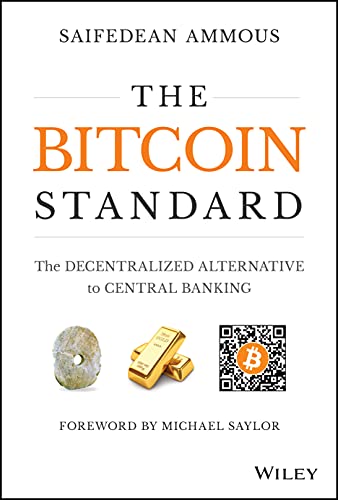
The Bitcoin Standard: The Decentralized Alternative to Central Banking was published by John Wiley & Sons on April 24, 2018. Its author, Saifedean Ammous, was a Lebanese-American economist who had been teaching at the Lebanese American University and writing on monetary economics from a perspective informed by the Austrian school. The book ran to 304 pages, was structured as a long argument from first principles, and made a single sustained claim: that bitcoin was the most sound form of money the human species had ever devised, and that its emergence represented a watershed in monetary history comparable to the demonetization of silver in the late nineteenth century or the abandonment of the gold standard in the twentieth.
The book’s argumentative spine was historical rather than technical. Ammous spent the first half tracing the development of money — from primitive shell-money and Rai stones, through silver and gold, into the era of central-bank-issued fiat — with particular attention to the property he called stock-to-flow: the ratio of an asset’s existing supply to the rate at which new supply could be added. Gold’s high stock-to-flow, in this telling, was the source of its monetary durability across millennia. Fiat currencies, whose stock-to-flow could be reduced to zero by the issuance decisions of a single central bank, were structurally inferior. Bitcoin, with its hardcoded supply schedule and asymptotically infinite stock-to-flow, was the first asset in human history to combine gold’s monetary properties with the additional features of digital divisibility, instant global transmission, and self-sovereign custody. This was, in Ammous’s framing, not a marginal improvement. It was a category change.
The book’s reception within the bitcoin community was rapid and intense. By the end of 2018, it had become the single most-recommended book in the maxi-aligned wing of the community, displacing the Bitcoin whitepaper itself as the canonical first-read for newcomers. Bitcoin podcasts began structuring entire episodes around its chapters. Conferences invited Ammous to keynote. The phrase Austrian economics — previously confined to a narrow academic and libertarian audience — became part of the standard bitcoin vocabulary, deployed in tweets, threads, and conference panels with a frequency that economists in actual Austrian-school programs found both gratifying and faintly alarming. The book’s reception outside the bitcoin community was substantially cooler. Mainstream economists, where they engaged with it at all, found its central arguments either question-begging, historically tendentious, or both. The disagreement, by 2020, had hardened into a stable standoff: bitcoiners cited Ammous as foundational; non-bitcoiners cited him as evidence of bitcoin’s intellectual provincialism.
What the book actually accomplished, distinct from its specific arguments, was that it gave the bitcoin maximalist community its first systematic theoretical justification. Before The Bitcoin Standard, the case for bitcoin had been made primarily through technical documentation, libertarian intuition, and the occasional incidental endorsement from a sympathetic economist. After The Bitcoin Standard, the case had a 304-page footnoted argument, a unified vocabulary, and a respectable academic lineage. Whether that argument was correct was a question that would continue to be litigated. That bitcoin now had an argument — one that could be cited, debated, and recommended to one’s father — was no longer one.
Ammous has since written two follow-up volumes — The Fiat Standard in 2021 and Principles of Economics in 2023 — neither of which has matched the original’s cultural traction. The Bitcoin Standard, by 2025, had sold over half a million copies, been translated into more than thirty languages, and become a kind of liturgical object in bitcoin culture. Its presence on a guest’s bookshelf, visible during a video podcast appearance, functions in the maxi community roughly the way a copy of The Wealth of Nations once functioned among nineteenth-century classical liberals: as a credential, a signal, and a closed argument that no longer needs to be made because the book has already made it.