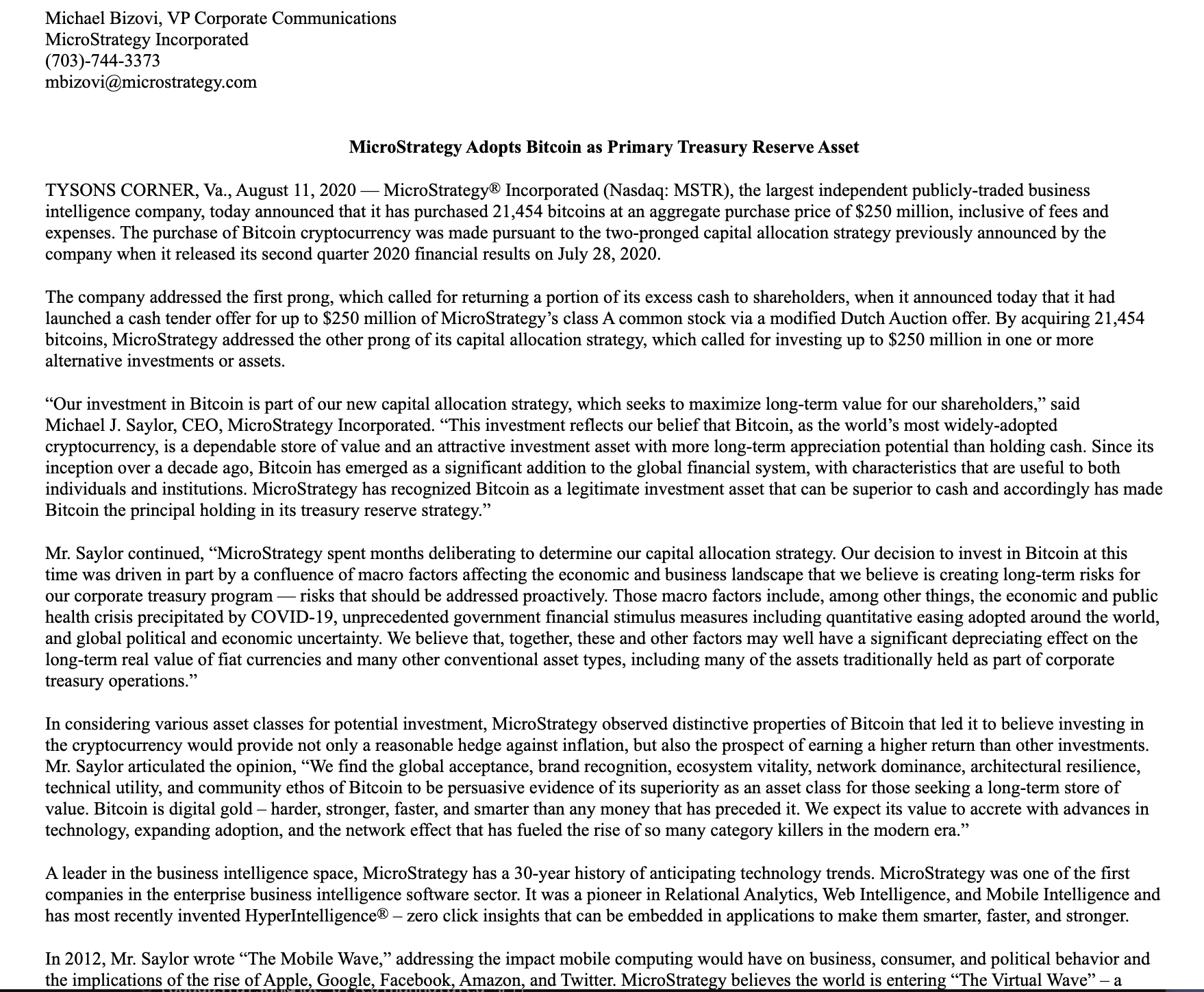
On August 11, 2020, an enterprise software company called MicroStrategy filed a Form 8-K with the United States Securities and Exchange Commission disclosing that it had purchased 21,454 bitcoin for an aggregate of approximately $250 million in cash. The filing identified the purchase as part of a new corporate treasury policy under which bitcoin would serve as the company’s primary treasury reserve asset. MicroStrategy was, at the time, a publicly traded company with a market capitalization of roughly $1.2 billion, a niche business intelligence product, and forty years of operational history. Its founder and chief executive officer, Michael Saylor, was fifty-five years old and had until recently been on record as a bitcoin skeptic.
The strategic logic, as Saylor explained it in subsequent communications, was monetary. MicroStrategy was sitting on roughly $500 million in cash that was earning a real yield of approximately negative ten percent in an environment of zero-bound interest rates and accelerating dollar issuance. Holding cash as a treasury reserve, in his framing, was no longer a conservative position; it was a slow-bleed position whose losses would compound for as long as monetary expansion continued. Bitcoin, by contrast, had a fixed supply schedule, a defensible scarcity argument, and a fifteen-year track record of surviving every prediction of its imminent collapse. Whether the analysis was right was a matter of debate. That it was unprecedented for a public-company chief executive officer to make it, on the record, in a regulatory filing, was not.
MicroStrategy did not stop at the initial purchase. By the end of 2020 the company had acquired 70,469 bitcoin. By the end of 2021, 124,391. The acquisition pace accelerated in 2024 after the spot bitcoin exchange-traded funds were approved and after Saylor renamed the company Strategy to reflect what was, by then, its actual business model: an equity instrument that held bitcoin and issued debt and stock to acquire more of it. As of mid-2025, the company held in excess of 580,000 bitcoin, representing approximately 2.7 percent of the total supply that will ever exist, and its stock had become the most heavily-correlated bitcoin proxy on any major exchange.
The cultural significance went beyond the balance sheet. Saylor became, over the four years following the initial buy, the most visible advocate for corporate bitcoin treasury adoption — appearing on financial news programs, podcasts, and conference stages with a fluency for the asset’s monetary case that no previous public-company chief executive had matched. His framing — that bitcoin was digital property, that fiat currency was a melting ice cube, that every responsible corporation should hold a portion of its treasury in the asset — was widely adopted, and at least as widely mocked. By 2025, dozens of public companies in the United States, Japan, Brazil, Germany, and elsewhere had announced bitcoin treasury allocations. Saylor himself referred to these companies, with some justification, as the MicroStrategy template.
What the August 2020 filing established was that a publicly traded American company could put bitcoin on its balance sheet, file the appropriate disclosures, weather the auditor’s questions, and continue operating. Whether other companies would follow was, on the day of the filing, an open question. Whether they had — by the time the filing’s anniversary was being celebrated by the bitcoin community as something approaching a holiday — was no longer one.