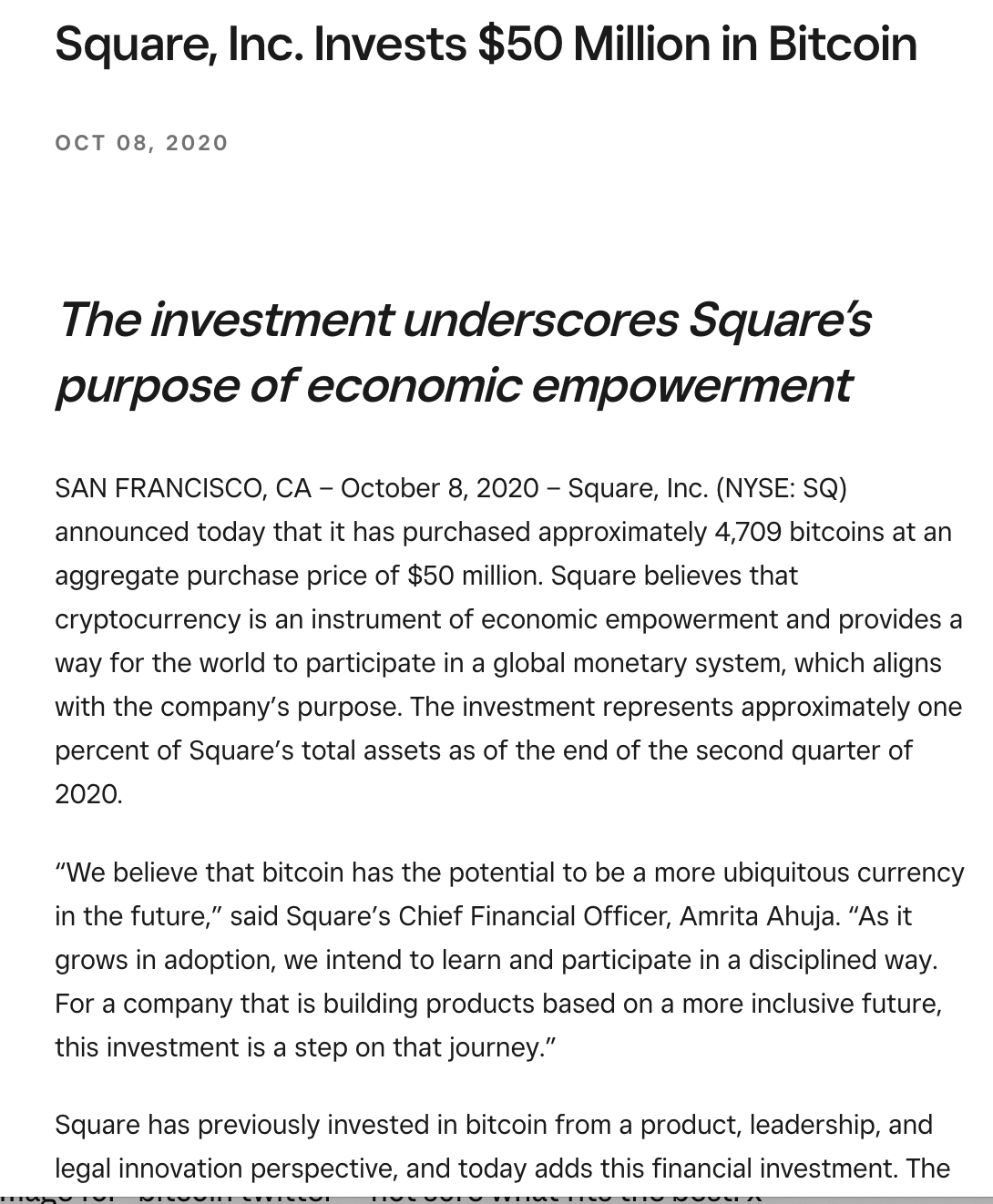
On October 8, 2020 — fifty-eight days after MicroStrategy’s initial bitcoin purchase had established the corporate-treasury template — Square, Inc., the payments company founded by Jack Dorsey in 2009, announced that it had purchased 4,709 bitcoin for approximately $50 million. The disclosure was made through a press release, an SEC Form 8-K, and a six-page accompanying white paper titled Bitcoin Investment Whitepaper that documented Square’s reasoning, custody arrangements, and execution methodology. The dollar amount was modest by Square’s standards — approximately one percent of the company’s total assets — but the strategic significance was substantially larger than the figure suggested. Square was not a niche software company. It was a publicly traded payments processor with millions of merchant customers, a consumer payments product called Cash App that had introduced bitcoin trading to retail users in 2018, and a chief executive officer whose other public company, Twitter, made him among the most-watched executives in technology.
The framing was different from MicroStrategy’s. Where Saylor had argued for bitcoin as a long-term treasury reserve against fiat debasement, Square’s published reasoning emphasized the company’s identification with bitcoin as a consistent and active strategic interest — language that positioned the purchase less as a defensive treasury maneuver and more as an institutional vote of confidence in an asset central to Square’s product strategy. Cash App had, by 2020, become one of the largest consumer onramps to bitcoin in the United States. The company’s purchase of bitcoin onto its own balance sheet was, in this framing, a coherent extension of a business model that already depended on the asset’s continued relevance.
The market response was characteristically sharp. Bitcoin’s price rose approximately twelve percent in the week following the announcement and would continue rising through the remainder of 2020, reaching its previous all-time high in mid-December and breaking decisively above it shortly thereafter. Whether Square’s purchase had caused the price action or merely coincided with it was a question that, in bitcoin’s reflexive trading environment, did not admit of clean separation. The corporate-bitcoin-buy as a recognized market event had, after October 2020, become an established phenomenon. Each subsequent corporate disclosure — Tesla in February 2021 most prominently — would be received against the template that MicroStrategy had created and Square had reinforced.
Dorsey himself became, over the subsequent years, the most publicly bitcoin-aligned chief executive officer of any major American technology company. He posted bitcoin-related content frequently to Twitter, used the bitcoin symbol in his social-media bios, and in 2021 announced that Square’s name would change to Block — a reference both to the bitcoin blockchain and to a broader corporate strategy organized around decentralized financial infrastructure. He resigned from Twitter in November 2021 to focus, in his subsequent communications, primarily on bitcoin and on Block’s bitcoin-aligned product development. The company’s bitcoin holdings have, by 2025, increased modestly through additional purchases but have never approached the scale of MicroStrategy’s accumulation. The strategic posture has remained consistent: bitcoin as an asset whose existence aligned with the company’s product mission, rather than as the company’s primary reason for existing.
The cultural significance of the October 2020 purchase, distinct from its specific dollar amount, was that it confirmed MicroStrategy had not been an isolated case. A second publicly traded company, with a substantially larger market capitalization and a more mainstream business model, had reached the same conclusion. The thesis that bitcoin was a legitimate corporate treasury holding was no longer the eccentric position of one CEO. It was, by the end of 2020, a position that two CEOs were defending in regulatory filings and that a third would shortly join.