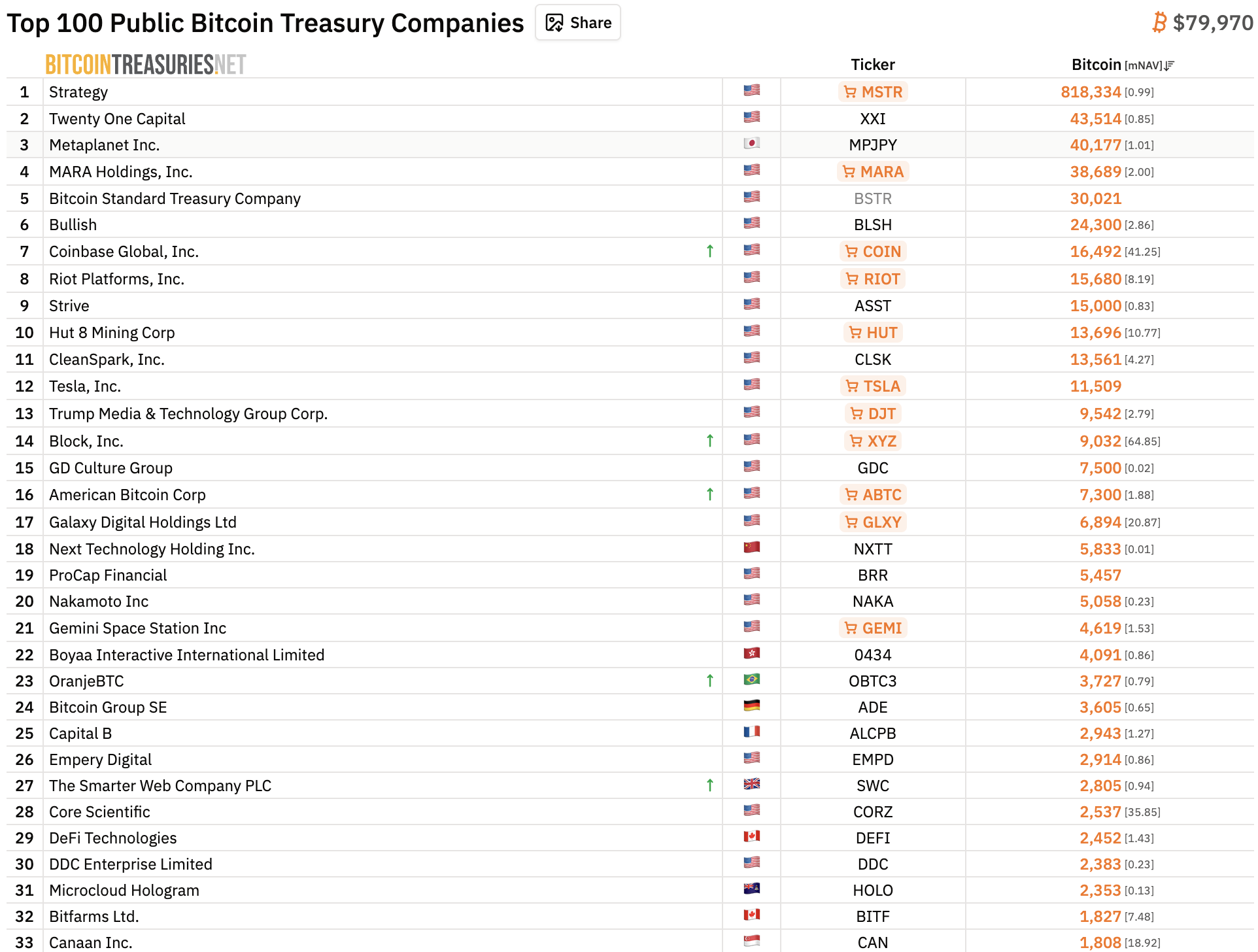
The Treasury Strategy is the catalogs first entry that is a pattern rather than an event. The pattern began on August 11, 2020, when MicroStrategy — a publicly-traded business intelligence software company headed by Michael Saylor — announced it had purchased 21,454 bitcoin for $250 million as its primary corporate treasury reserve asset. The decision was novel. Public companies held cash and short-term treasuries; they did not hold bitcoin. By 2025 the picture had changed. Roughly two hundred publicly-traded companies, with combined holdings approaching one million bitcoin, had implemented some version of what MicroStrategy started.
The mechanism is reflexive in a way that is best understood by following the math. A public company issues equity, or convertible notes, or preferred shares, and uses the proceeds to buy bitcoin. The bitcoin holdings appear on the balance sheet. The companys stock price reflects the market value of those bitcoin, sometimes at a premium because investors are buying leveraged exposure they cannot easily get otherwise. The premium itself becomes raw material: the company can issue more equity at the elevated price and use the proceeds to buy more bitcoin, which raises the bitcoin holdings, which sustains the premium, which enables the next issuance. Saylor described this as a flywheel. Critics described it as something else. Both descriptions referred to the same mechanism.
What gives the strategy artifact-status, rather than just company-status, is that MicroStrategy published the playbook. In 2021 and 2022 the company released an open-source set of documents under a section of its website titled the Bitcoin Initiative Project Roadmap. The documents covered treasury policy, board approval mechanics, custody arrangements, accounting treatment, and capital structure. The company was, explicitly, inviting other public companies to copy what it had done. The catalog has not seen this before — a corporate strategy released as open-source documentation, with an implicit invitation to fork.
The forks came. Metaplanet, a Tokyo-listed company, pivoted into bitcoin treasury operations in April 2024 and by mid-2025 held over 40,000 bitcoin. Semler Scientific, a small medical-device company, adopted the strategy in May 2024. Twenty One Capital, a 2025 venture led by Jack Mallers and backed by Tether, SoftBank, and Cantor Fitzgerald, was structured from inception as a bitcoin-treasury company and began with a multi-billion-dollar bitcoin position. MARA Holdings, a bitcoin miner, expanded its strategy from accumulating its own mining output to systematic treasury accumulation. Bitcoin Standard Treasury Company emerged as a pure-play vehicle. By the second half of 2025, the publicly-traded bitcoin treasury company had become a recognizable category of public equity, traded by funds with names that contained the word treasury, covered by analysts whose beats had not existed five years earlier.
MicroStrategy itself rebranded to Strategy in 2025 and now holds over 800,000 bitcoin — roughly four percent of total supply. Saylor has said the company will never sell. Whether this is true is unprovable until it is tested; what is true is that the companys public commitment to never selling is itself part of the strategy, because it stabilizes the bitcoin held against any forced-liquidation scenario short of bankruptcy, which the companys capital structure has been engineered to make very difficult.
The catalog records the Treasury Strategy as a single artifact because the pattern is what matters. Individual companies copying MicroStrategys playbook are not, individually, catalog-worthy; the act of MicroStrategys playbook being a copyable thing is. This entry is the first the catalog has produced that is structured this way, and the editorial wager is that it works. The artifact is the propagation. The propagation has names — Saylor, Mallers, Metaplanet, the rest — but the artifact is not any of them. It is the diffusion of a corporate-finance pattern from one outlier to a recognizable asset class within five years. The catalog is grateful to MicroStrategy for publishing the playbook openly enough that the pattern can be traced. Without that publication, the propagation would be untraceable, and the strategy would look like a series of independent decisions rather than what it is: a copy.
A note on the political character. The Treasury Strategy is not ideologically neutral. It is, in its premises, a wager that fiat currencies will continue to debase faster than productive cash assets compound, and that bitcoin will outperform both. The companies adopting it are, as a class, betting against the dollar. This is not stated in their press releases in those terms. The catalog states it because the pattern is otherwise illegible.