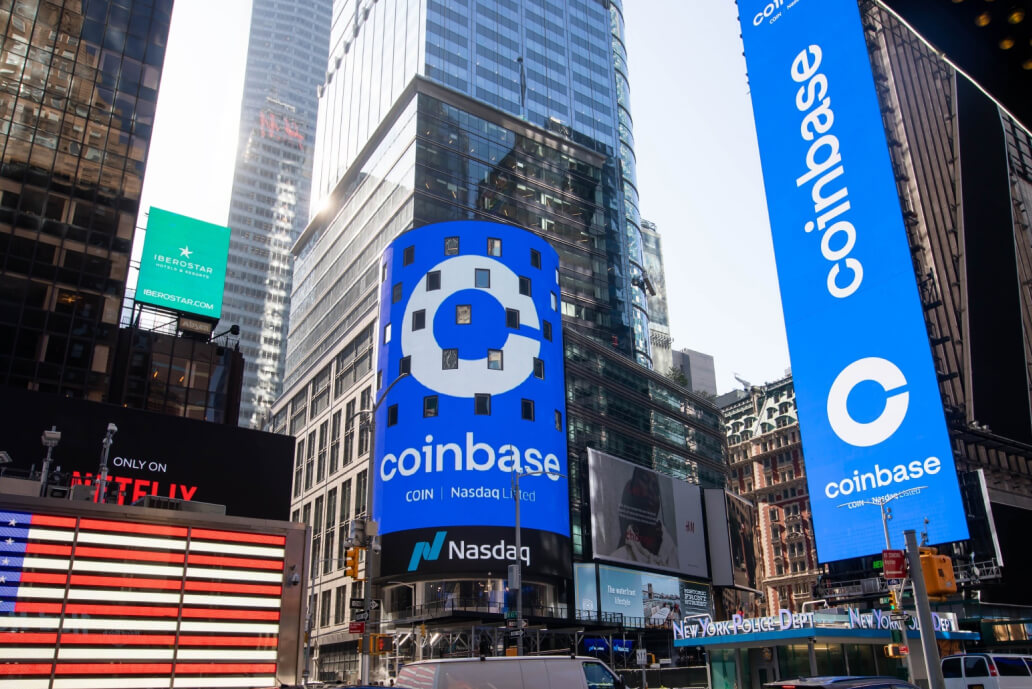
On the morning of Wednesday, April 14, 2021, Coinbase Global, Inc. — the largest cryptocurrency exchange in the United States — began trading on the NASDAQ under the ticker COIN. The listing was a direct listing rather than a traditional initial public offering: Coinbase did not issue new shares or raise capital from the public markets, but instead allowed its existing shareholders to begin selling their shares directly to public investors at the prevailing market price. The reference price set by NASDAQ the night before was $250 per share. The first trade executed at $381. By the close of the first trading day, COIN had reached $328.28, valuing the company at approximately $86 billion at fully diluted share count — larger, on opening day, than the parent company of the New York Stock Exchange.
The company being valued had been founded in 2012 by Brian Armstrong, a former Airbnb engineer, and Fred Ehrsam, a former Goldman Sachs trader. It had taken $30,000 in seed funding from Y Combinator that summer, raised approximately $500 million in venture capital across the subsequent decade, and grown — through a combination of regulatory cooperation, conservative product strategy, and the broader cryptocurrency adoption wave — into the dominant American on-ramp for retail bitcoin acquisition. By the time of the listing, Coinbase had approximately 56 million verified users, $1.8 billion in 2020 revenue, and a market position that had survived the failures of essentially every comparable competitor.
The cultural significance of the listing was substantial and structural rather than incremental. For the first decade of bitcoin’s existence, the asset had been associated, in the institutional imagination, with a parade of ill-fated counterparties — Mt. Gox, BTC-e, Quadriga, and a long tail of smaller failures — whose mismanagement, fraud, or operational failure had made cryptocurrency exposure a reputational risk for any traditional financial institution that took it seriously. Coinbase’s listing, in addition to whatever it meant for Coinbase’s shareholders, retired that association at the institutional level. A bitcoin-aligned company could now be held in mutual funds, listed on the major American exchanges, covered by sell-side equity analysts, and discussed in earnings calls without the institutional adopter needing to apologize for the affiliation. The asset class had, in the regulatory and capital-markets sense, gone public.
Coinbase’s stock subsequently had a turbulent ride that has tracked, in broad strokes, the bitcoin price cycle that contained it. COIN reached an all-time high of approximately $429 in November 2021, fell to below $33 in the bear market of 2022, and recovered to over $300 by mid-2025. Its commercial fortunes, similarly, have followed the cycle: the company’s revenue grew rapidly through the bull markets, contracted dramatically in the 2022 downturn, and was forced into substantial layoffs in 2022 and 2023 before stabilizing as the spot ETF approval restored institutional bitcoin flows. Through all of it, Coinbase remained the largest American on-ramp, the most-cited counterparty for spot ETF custody arrangements, and the publicly-traded reference for what a bitcoin company looked like when it was successful.
The April 2021 listing’s most lasting legacy is that it normalized the existence of bitcoin-native publicly traded companies. Block, formerly Square, was already public but had bitcoin as one product among many. Coinbase was the first company whose entire business was structured around the cryptocurrency economy and that could survive public-market scrutiny. Subsequent listings — Bitfarms, Marathon Digital, Riot Platforms, CleanSpark, and the long tail of public bitcoin miners — followed in Coinbase’s wake. The bitcoin sector, after April 14, 2021, had a public-markets infrastructure of its own. Whether that infrastructure was a good thing for bitcoin remained, like most questions in bitcoin, contested. That it existed was no longer.