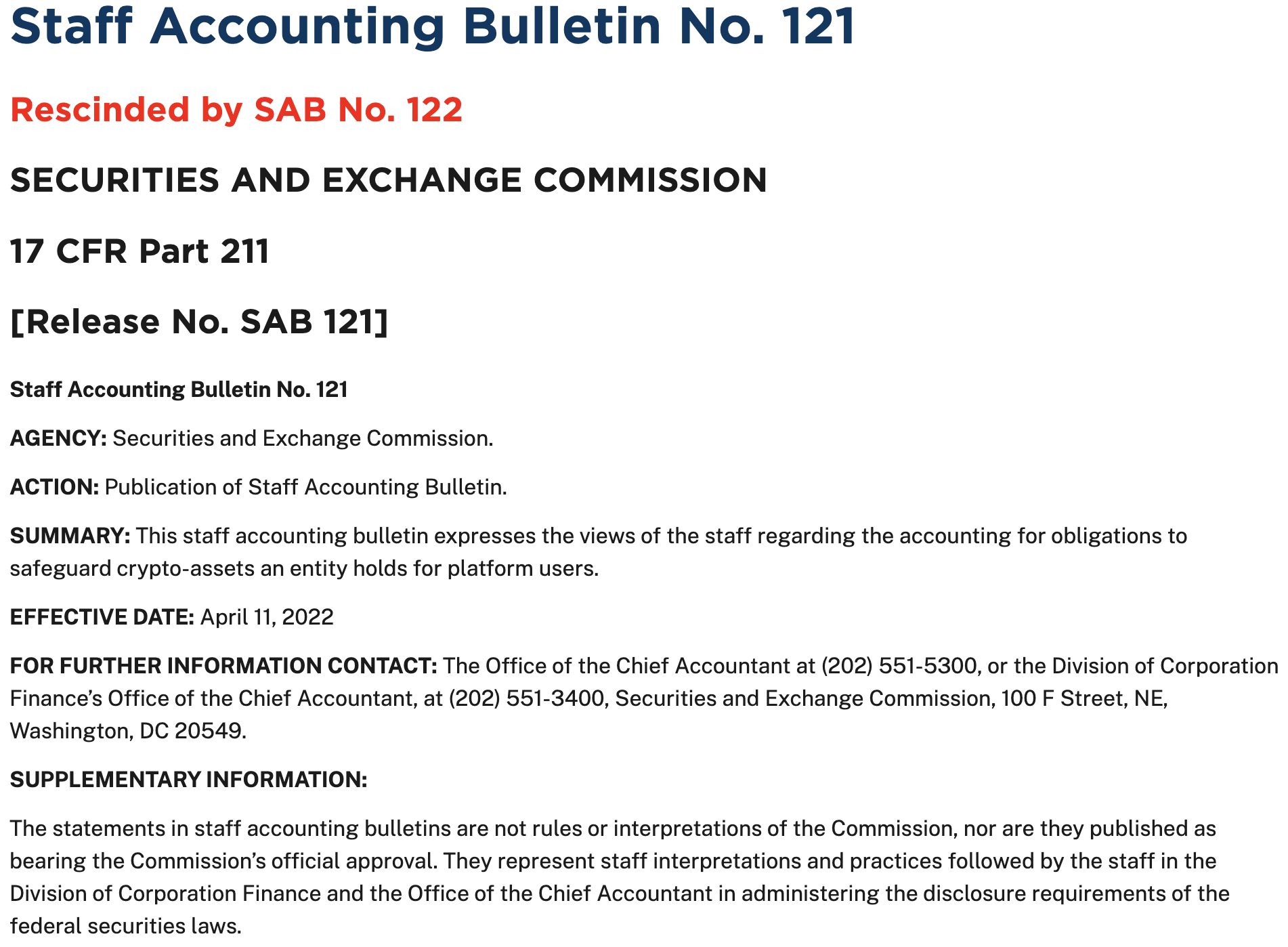
On March 31, 2022, the staff of the U.S. Securities and Exchange Commission issued Staff Accounting Bulletin No. 121. The document was four pages long. It was not a rule, in the formal sense; staff bulletins are interpretive guidance rather than regulation, and they do not pass through the rulemaking process that requires public comment, cost-benefit analysis, or congressional review. SAB 121 was issued by a handful of staff under SEC Chair Gary Gensler and took effect immediately. Its content, in plain terms, was that any publicly-traded company that safeguarded crypto assets on behalf of customers had to record those assets as a liability on its own balance sheet, with a corresponding asset of equal magnitude.
The accounting treatment was unusual. Custodians do not typically record customer assets on their own books — a bank holding a customers stock certificates does not list those shares as a bank liability. SAB 121 created a special rule for crypto, on the theory that the technological and regulatory risks of crypto custody were uniquely severe and that balance-sheet recognition was the appropriate response. The practical effect was that any bank wishing to offer bitcoin custody would have to hold capital against the full notional value of customer holdings, the same way it would for its own loans or trading positions. For a bank with substantial bitcoin under custody, this meant capital requirements could exceed the entire revenue of the custody business by orders of magnitude. The math did not work. American banks did not enter the bitcoin custody market.
This was, depending on how one read it, either a prudent accounting position responding to a genuine novel risk, or a deliberate barrier erected to exclude regulated banks from a financial product the SEC chairmanship disapproved of. The bitcoin community read it as the second. Through 2022, 2023, and 2024, SAB 121 was cited repeatedly as the central piece of regulatory friction keeping bitcoin out of mainstream American banking. SEC Commissioner Hester Peirce, a Republican appointee who dissented from much of Genslers approach, called SAB 121 a pernicious weed in April 2023 and continued to call for its rescission throughout. A bipartisan congressional resolution to overturn it passed both chambers in May 2024. President Biden vetoed it. The veto held.
The reversal came with the change in administration. Gary Gensler resigned on January 20, 2025, the day Donald Trump took office. Three days later, on January 23, 2025, the SEC issued Staff Accounting Bulletin No. 122, which formally rescinded SAB 121. Hester Peirce posted on X: bye, bye SAB 121. Its not been fun. Within weeks, several major American banks announced or expanded crypto custody services. The capital and operational barriers had not changed; only the accounting interpretation had. A four-page document had blocked an industry for thirty-three months.
The artifact is the arc, not just the bulletin. SAB 121 demonstrated, with unusual clarity, how American financial regulation actually operates: not principally through statute but through interpretation, and not principally through public process but through staff guidance that arrives without warning and departs without much more. The bitcoin industry spent three years arguing that it was being kept out of the banking system by a document that had never been voted on. They turned out to be right. When the document was withdrawn, the system opened.
What remains is the precedent, which cuts both ways. The mechanism that excluded bitcoin custody for thirty-three months can be re-deployed, in a different administration, against any other class of asset the SEC staff would prefer banks not touch. SAB 121 was rescinded. SAB 122 can be rescinded too. The catalog records SAB 121 as the artifact of that fragility — a multi-year exclusion of an entire asset class from the American banking system, achieved through a four-page interpretive document, dismantled in three days by a different staff.