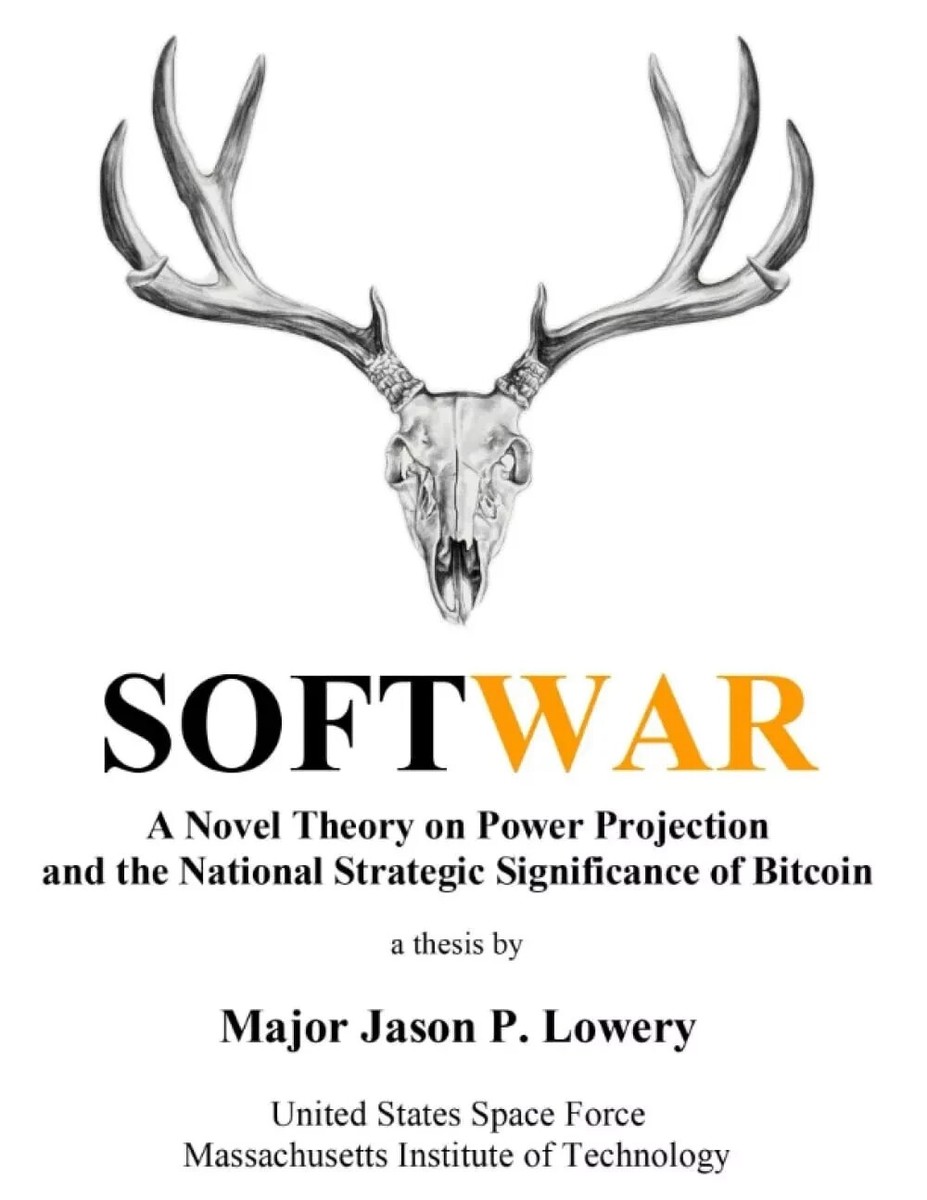
In February 2023, Major Jason Lowery, a U.S. Space Force officer and National Defense Fellow at MIT, submitted a four-hundred-page thesis to the Institute’s System Design and Management Program. He titled it Softwar: A Novel Theory on Power Projection and the National Strategic Significance of Bitcoin. The thesis was published as a paperback the same month. By March it was a top seller in Amazon’s digital currencies category and rising in technology and engineering. By July, it had been removed from sale, withdrawn from the MIT library catalogue, and Lowery had been ordered, in his own description, to stop discussing the subject publicly.
Lowery’s argument was a deliberate departure from how bitcoin was usually framed. The whitepaper had described bitcoin as a peer-to-peer electronic cash system; almost every analysis since had taken the framing for granted, treating bitcoin as a monetary technology to be evaluated against monetary criteria. Lowery proposed instead that bitcoin’s proof-of-work network was, more fundamentally, a power-projection technology — a way to impose physical costs through cyberspace, comparable in function to how nation-states had historically used kinetic force in physical space. The thesis drew on military strategic theory, evolutionary biology, anthropology, and political science to develop a framework Lowery called Power Projection Theory. Bitcoin’s energy expenditure, in this reading, was not waste; it was the mechanism by which the network projected non-lethal physical force into a domain that had previously been defended only by abstractions like cryptography and law.
The framework was original and strange. Lowery compared the energy bitcoin’s miners burn to the metabolic cost of an elk’s antlers, the physical signaling mechanism by which conspecific males establish dominance without lethal violence. He proposed a notation he called the Bowtie Notation for analyzing the benefit-to-cost ratio of attack on any resource. He argued that nations would, within decades, recognize bitcoin and similar proof-of-work systems as strategic-defense infrastructure on par with nuclear deterrence, and that the United States should accumulate hashrate accordingly. Reception was polarized. Bitcoiners with national-security framings found the argument clarifying; cypherpunks with anti-state framings found the argument’s conclusion — that bitcoin is a national-security imperative for the U.S. government — close to a betrayal of bitcoin’s founding politics. Technical readers questioned the precision of the digital energy metaphor.
What removed Softwar from circulation has not been publicly explained. Lowery posted to Twitter on July 27, 2023: I was ordered to take SOFTWAR down and asked to stop talking about the subject publicly. Can’t talk details but things are good and I’m working hard behind the scenes. The Department of Defense was reported to have initiated a retroactive security review of the text; the specific national-security concern, if any, has not been disclosed. The MIT thesis itself remained accessible through MIT’s institutional repository and through Air University’s library system; the published paperback, however, was pulled from Amazon, ThriftBooks, and Google Shopping. Secondary-market prices for physical copies climbed into the hundreds of dollars. The takedown produced a Streisand effect of the kind reliably produced by takedowns: the book was suddenly more widely discussed than it had been in any month before its removal.
Softwar’s significance is unsettled, and the catalog records it as such. It is the most prominent attempt to date to read bitcoin through a strategic-defense lens, the most prominent example of a serving U.S. military officer publishing a sustained argument for state adoption of bitcoin, and the most prominent case of a bitcoin book being withdrawn from circulation by the institution that had been responsible for its publication. Whether the framework is right, whether the takedown was justified, and whether bitcoin will be remembered as a monetary system or as something else are questions the catalog does not answer. What the catalog records is that the argument was made, the book was pulled, and the bitcoin community now reads Lowery the way it reads any artifact whose meaning is still being established.