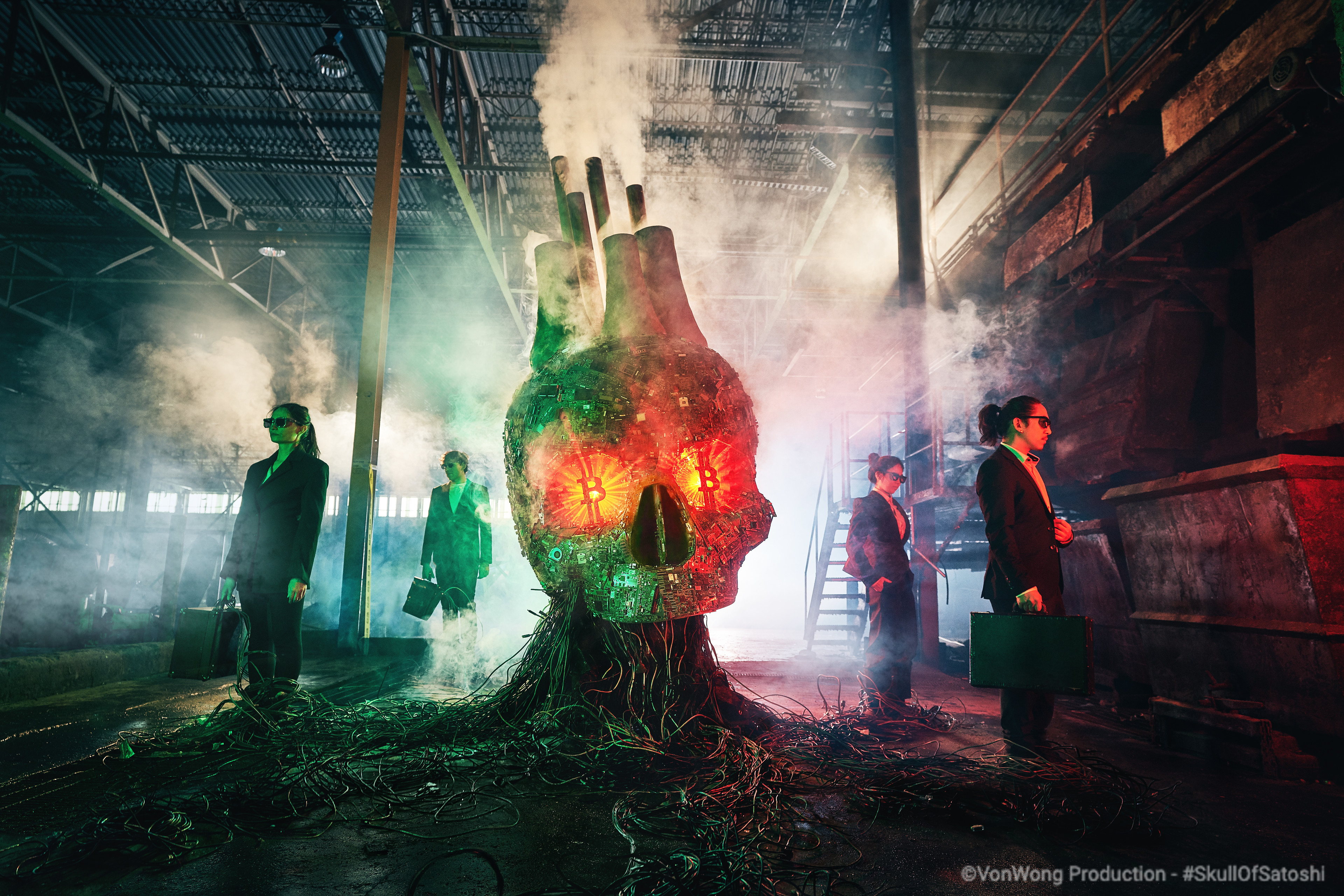
On March 23, 2023, Greenpeace USA unveiled an eleven-foot sculpture in Washington DC. It was a human skull made from over three hundred pieces of donated electronic waste, with smokestacks rising from the cranium, red laser-light eyes, suit-wearing models posed in front of it, and cables protruding from the neck. It was titled the Skull of Satoshi. Its commissioned purpose was to indict bitcoin for climate destruction. Within forty-eight hours, bitcoin Twitter had adopted it as a mascot.
The cultural artifact is the inversion. The sculpture itself, considered as an object, is well-made. Benjamin Von Wong, the Canadian environmental artist who built it, has a serious career in viral activist installations — closets nine meters tall made from one lifetime of clothing, plastic-straw mountains in Vietnam, a twenty-foot mermaid drowning in plastic bottles. The Skull of Satoshi was commissioned by Greenpeace USA as part of the $5 million Change the Code, Not the Climate campaign launched March 29, 2022, calling for bitcoin to switch from proof-of-work to proof-of-stake. The campaign was funded substantially by Chris Larsen, co-founder of Ripple — a competing cryptocurrency whose proof-of-stake consensus would directly benefit from bitcoins discrediting. Bitcoiners did not forget this.
What Von Wong appears not to have anticipated was that the iconography he chose would read, to bitcoiners, as flattering. Red laser eyes had been a bitcoin Twitter signal since the LaserRayUntil100K meme of February 2021. Skulls have been an aesthetic staple of bitcoin iconography since well before that. The smokestacks read, to anyone outside the Greenpeace target audience, as metal. The whole installation looked like the cover of a particularly pretentious doom-metal album. Bitcoiners changed their profile pictures to it. Some shared it with the caption in honor of the Skull of Satoshi, Bitcoin isnt melting Greenland. Others made it a meme.
Two days after the unveiling, on March 25, Von Wong posted a Twitter thread that complicated the story further. He wrote that he had built the Skull believing bitcoin mining was a simple black-and-white issue, that proof-of-work felt intuitively wasteful, and that he had been wrong. He said the sculpture was never meant to be anti-bitcoin. He had spent the days since the unveiling speaking with environmentalist bitcoiners — Daniel Batten, Troy Cross, Level39 — and now recognized that bitcoin could be a force for environmental improvement, that mining could stabilize grids and monetize stranded methane, that the energy critique was more nuanced than his commission had assumed.
The artist had been re-orange-pilled by his own art piece in real time. The sculptures cultural meaning had inverted before it left Washington.
Greenpeace continued to use the Skull of Satoshi for the Change the Code campaign tour through 2023 and into 2024. Its effectiveness as anti-bitcoin propaganda was, by then, debatable. Bitcoin proof-of-work did not change. The European Parliament rejected a proposed proof-of-work ban in 2022. The Bitcoin Mining Council, formed in May 2021 partly in response to similar campaigns, continued to publish quarterly mining-energy reports. The Change the Code campaign quietly wound down. The skull, as a piece of bitcoin iconography, persisted.
The artifact is not the skull. The artifact is what happened to the skull. Greenpeace spent five million dollars trying to demonstrate bitcoins cultural defeat, and ended up commissioning the most metal piece of bitcoin merchandise the community has ever owned.
The community accepted the gift.