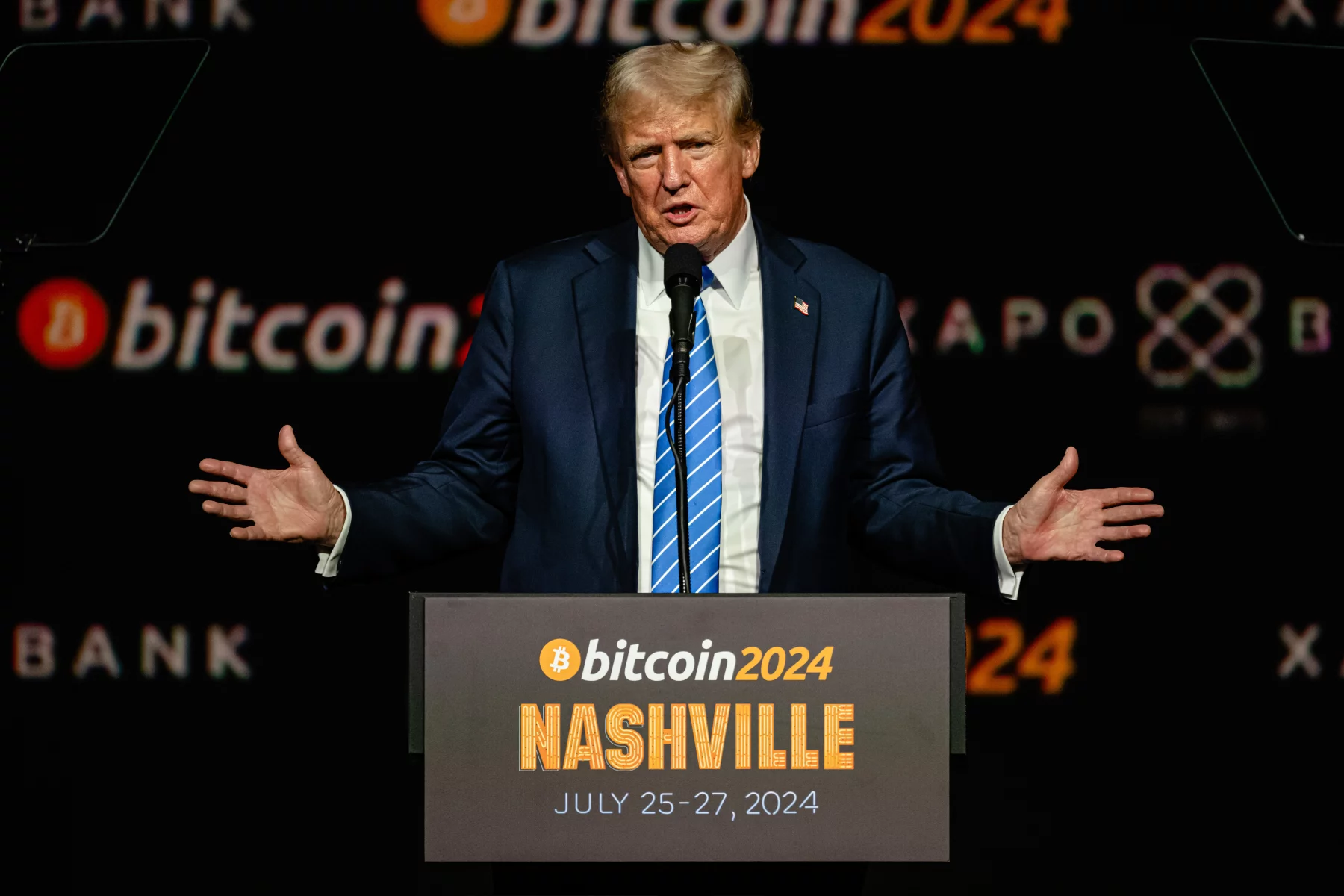
On the afternoon of Saturday, July 27, 2024, the Republican Party’s nominee for president of the United States walked onto a stage at the Bitcoin 2024 conference in Nashville, Tennessee, in front of an audience of approximately twenty thousand bitcoiners, and delivered a fifty-minute address committing his prospective administration to a series of bitcoin-friendly policy positions. The candidate was Donald J. Trump. The positions, as articulated in the speech and subsequently formalized in campaign documents, included: maintaining the United States government’s existing bitcoin holdings as a strategic national stockpile; protecting the right of every American to self-custody their bitcoin; firing the chair of the Securities and Exchange Commission, Gary Gensler, on day one of the new administration; and ensuring that bitcoin mining occurred in America, not in jurisdictions less aligned with American interests. The audience response was enthusiastic to the point of being audibly emotional. The political significance was substantially independent of the specific commitments.
Trump’s relationship to bitcoin had not, prior to the speech, been entirely settled. As recently as 2021, his public statements about cryptocurrency had been negative; he had described bitcoin as a scam in a Fox Business interview that summer. The pivot, by 2024, was approximately complete. The reasons offered varied depending on the source. Trump’s own framing emphasized American competitiveness, particularly relative to China; campaign-aligned commentary emphasized the bitcoin community’s growth into a constituency of approximately fifty million American adults whose preferences could plausibly affect a close election; cynical observers emphasized the substantial campaign donations the bitcoin industry had begun directing toward Trump’s reelection effort during 2024. Whatever the precise mix of motivations, the result was that the Republican nominee was, by the time of the Nashville address, the more bitcoin-friendly of the two major-party candidates by a substantial margin. The Democratic nominee at the time, Vice President Kamala Harris, had not addressed the conference and had not adopted comparable positions.
The speech’s most operationally significant promise was the strategic bitcoin reserve — the proposal that the United States government would establish a sovereign holding of bitcoin analogous to its strategic petroleum reserve and its gold reserves at Fort Knox. The proposal, in its initial Nashville framing, was modest: the government would simply not sell the approximately 200,000 bitcoin already in its possession, primarily seized from criminal cases including Silk Road and the Bitfinex hack. The framing escalated over the following months. Senator Cynthia Lummis introduced legislation, the BITCOIN Act, proposing that the United States acquire one million additional bitcoin over five years. The proposal was widely characterized as either visionary or fiscally insane, depending on which financial commentariat one consulted. The bitcoin community received it as the closest thing to government endorsement the asset had ever received from a major American political figure.
The cultural significance of Nashville, distinct from any specific policy outcome, was that bitcoin had crossed the threshold from politically inert asset to active campaign issue. For most of bitcoin’s history, the asset had been politically tolerated rather than embraced; presidents and presidential candidates had said little about it, regulators had argued among themselves about how to classify it, and the asset had grown in the spaces that institutional inattention left available. After Nashville, that arrangement was no longer sustainable. Bitcoin had a side. The side had a candidate. The candidate, in November 2024, won. The implications of that conjunction would unfold over the subsequent four years and would substantially shape the catalog entries that follow this one.
The speech itself, as a piece of political rhetoric, was characteristic Trump — discursive, anecdotal, occasionally factually loose, periodically substantively precise. The substantive claims have largely been kept since his inauguration. The specific framing of bitcoin as an asset whose proper home was the United States, and whose protection was a matter of American national interest, would have been unimaginable from any major-party nominee even four years earlier. By July 27, 2024, it was the official position of the candidate who would, six months and twenty-two days later, take the oath of office.