On January 21, 2025, the second day of his second term, President Donald J. Trump signed a full and unconditional pardon for Ross William Ulbricht — the founder of the Silk Road darknet marketplace, who had been convicted in 2015 of distributing narcotics, conspiring to commit money laundering, and several adjacent charges, and was at the time of the pardon serving two consecutive life sentences plus an additional forty years, without the possibility of parole. He had been incarcerated for slightly over eleven years. The pardon ended a campaign that had run, in some form, since the day he was sentenced.
The campaign was, throughout its existence, primarily run by Ulbricht’s mother, Lyn Ulbricht. Its slogan was Free Ross. Its argument was specific: Ulbricht’s sentence — handed down by Judge Katherine Forrest in May 2015 in the Southern District of New York — was disproportionate. Ulbricht had been twenty-six years old when he founded Silk Road in 2011, twenty-nine when arrested in October 2013. He was a first-time, non-violent offender. The murder-for-hire allegations that had loomed over the trial were never charged and never proven. The double life sentence, his supporters argued, was excessive even within the framework of American drug-law sentencing. The argument did not, for years, find a sympathetic political audience.
The Free Ross campaign’s natural constituencies were libertarians, bitcoiners, and a wider strain of criminal-justice-reform advocates who treated Ulbricht’s case as emblematic of a system willing to bury a young man for an offense that, from a certain angle, looked like building software. Pete Rizzo, a bitcoin historian, would later note that Ulbricht’s release on January 21 — 21 echoing bitcoin’s twenty-one-million-coin supply cap — produced a kind of numerological coincidence the bitcoin community, half-jokingly, treated as fitting. The coincidence had not been planned.
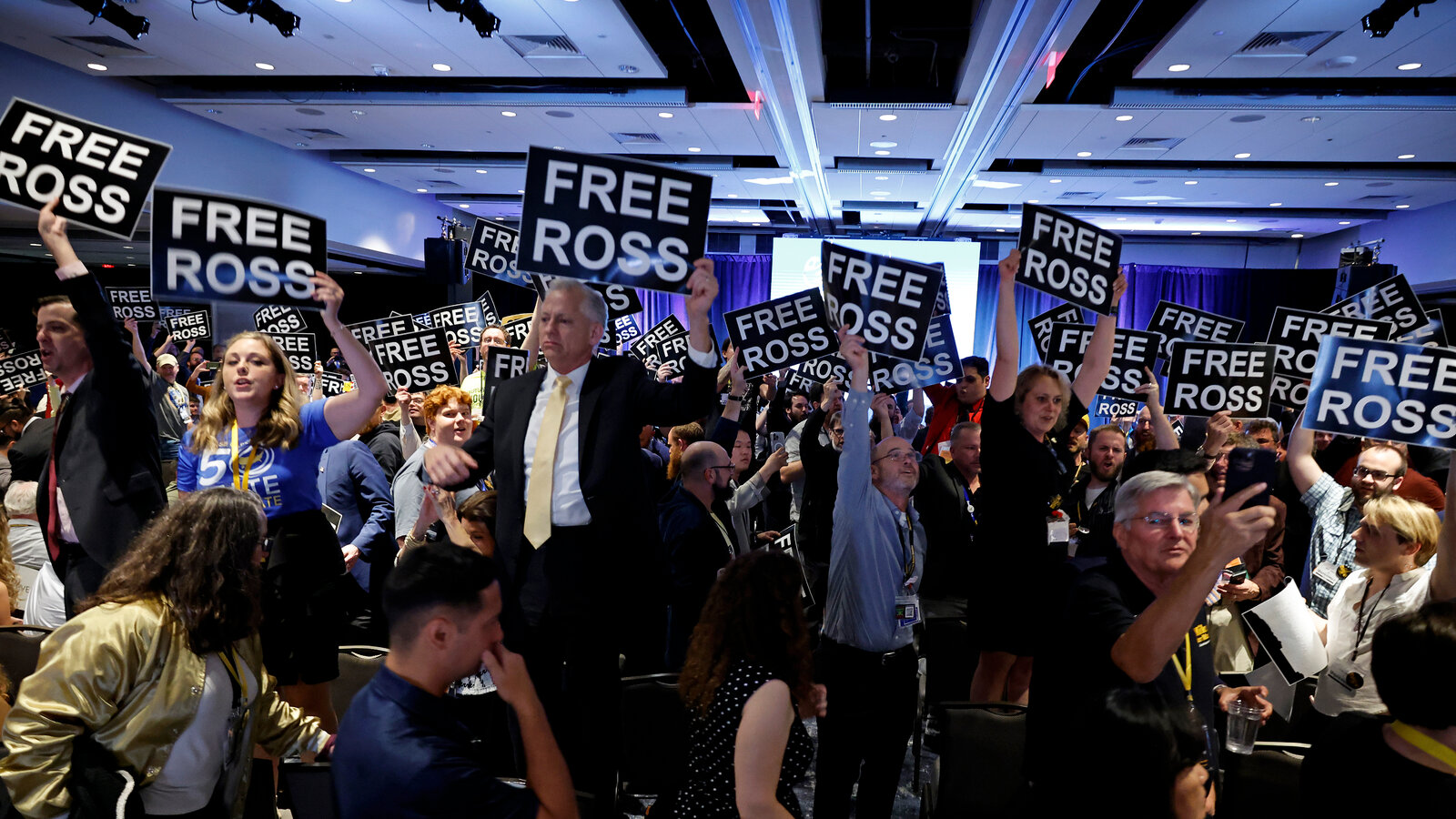
The political turn arrived in May 2024. At the Libertarian National Convention in Washington, D.C., Donald Trump — addressing a hostile audience of libertarians as a presidential candidate seeking their votes — pledged that on day one he would commute Ulbricht’s sentence. The crowd erupted into a chant of Free Ross. Ulbricht responded the next day from prison, dictating a thank-you statement to his wife. Trump reiterated the pledge two months later in his keynote address at the Bitcoin 2024 conference in Nashville. By the time of the November election, Ulbricht’s release had become, for a non-trivial slice of crypto-aligned voters, a litmus test the candidate had committed to passing.
The pardon, when it came, exceeded the commutation Trump had promised. A commutation would have ended Ulbricht’s sentence while leaving his convictions in place. A full and unconditional pardon erased the legal consequences of the conviction itself. Trump’s announcement on Truth Social described the prosecution as ridiculous and the prosecutors as scum. Ulbricht walked out of federal prison in the early hours of January 22, 2025. The Free Ross campaign account posted a photograph of him at liberty, captioned simply FREEDOM!!!!
The cultural significance of the moment was substantial in ways that exceeded the case itself. Free Ross had been, for over a decade, the bitcoin community’s longest-running active political cause — the one issue on which bitcoiners across every other ideological axis (institutional, libertarian, technical, maximalist) had agreed. Its conclusion folded together the Trump-era political alignment captured at Nashville and the older bitcoin commitment to the Silk Road moment in which the network first proved itself useful for things states would prefer it not be used for. Ulbricht, on the day of his release, was forty years old. He had been arrested before bitcoin was worth one hundred dollars. He emerged into a world in which it was worth more than one hundred thousand. The catalog records both the campaign and its conclusion.