 The Bitcoin Annotated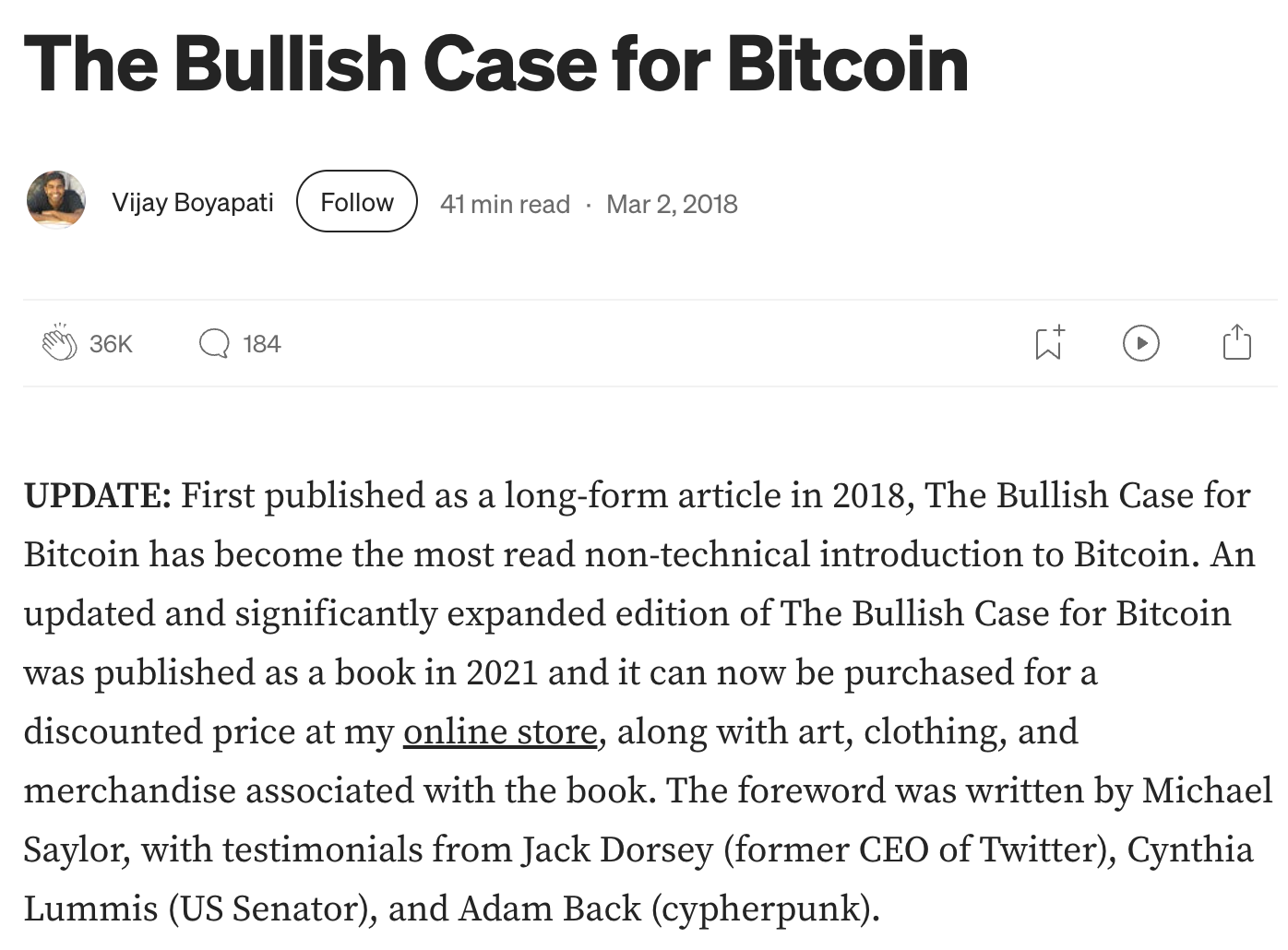
In March 2018, an Australian engineer named Vijay Boyapati published an essay on Medium called “The Bullish Case for Bitcoin.” It was a forty-minute read, opened with Carl Menger and Ludwig von Mises rather than bitcoin, and spent its first act on monetary history. It went on to become the most-read non-technical introduction to bitcoin ever written, eventually translated into more than twenty languages.
Boyapati was not a newcomer reaching for a frame. He had been around bitcoin since 2011, and in 2008 he had left a job at Google to campaign for Ron Paul in New Hampshire. The Austrian-economics lens was not chosen for persuasion; it was the one he had been looking through for a decade. What the essay did, and what almost no bitcoin writing before it had, was compress that lens into a single document a layperson could finish in one sitting and come away with an argument rather than a vocabulary. It explained why bitcoin might be money before it touched how bitcoin worked. The order was the point.
That order became a template. Theory of money first, then the properties that make a monetary good, then the long drift from collectible to store of value to medium of exchange. Bitcoin arrives late in the essay, located inside that history instead of asserted as an exception to it. Only then does Boyapati take up the standard objections — volatility, energy, regulation, the look of unbacked speculation — and answer each as a question the Austrians had already met somewhere else.
In June 2021, at the Miami conference, Boyapati expanded the essay into a book of the same name. Michael Saylor wrote the foreword; Jack Dorsey, Cynthia Lummis, and Adam Back supplied testimonials. But the book was downstream of the essay, not the reverse. By the time it appeared, the essay had circulated widely enough that publishing the long version documented a demand rather than creating one.
We file this as a Document rather than a Phrase because the artifact is the essay itself. People send the link. They ask whether you’ve read the bullish case. They cite it the way an earlier cohort cited the whitepaper or the Antonopoulos books, as the thing that explains bitcoin. No line ever broke loose to become an idiom. The work circulates as a work.
What makes it foundational is the gap it filled. Between the whitepaper in 2008 and Antonopoulos’s Mastering Bitcoin in 2014, nothing explained bitcoin to a non-technical reader as money. Antonopoulos explained the protocol. Ammous’s The Bitcoin Standard, later in 2018, argued a hard-money worldview and fit bitcoin into it. Boyapati’s essay was the bridge: monetary theory first, bitcoin as the instance second, written for someone who had not yet decided whether any of it was serious.
The essay is still free, still on Medium, still in the form it first appeared.