 The Bitcoin Annotated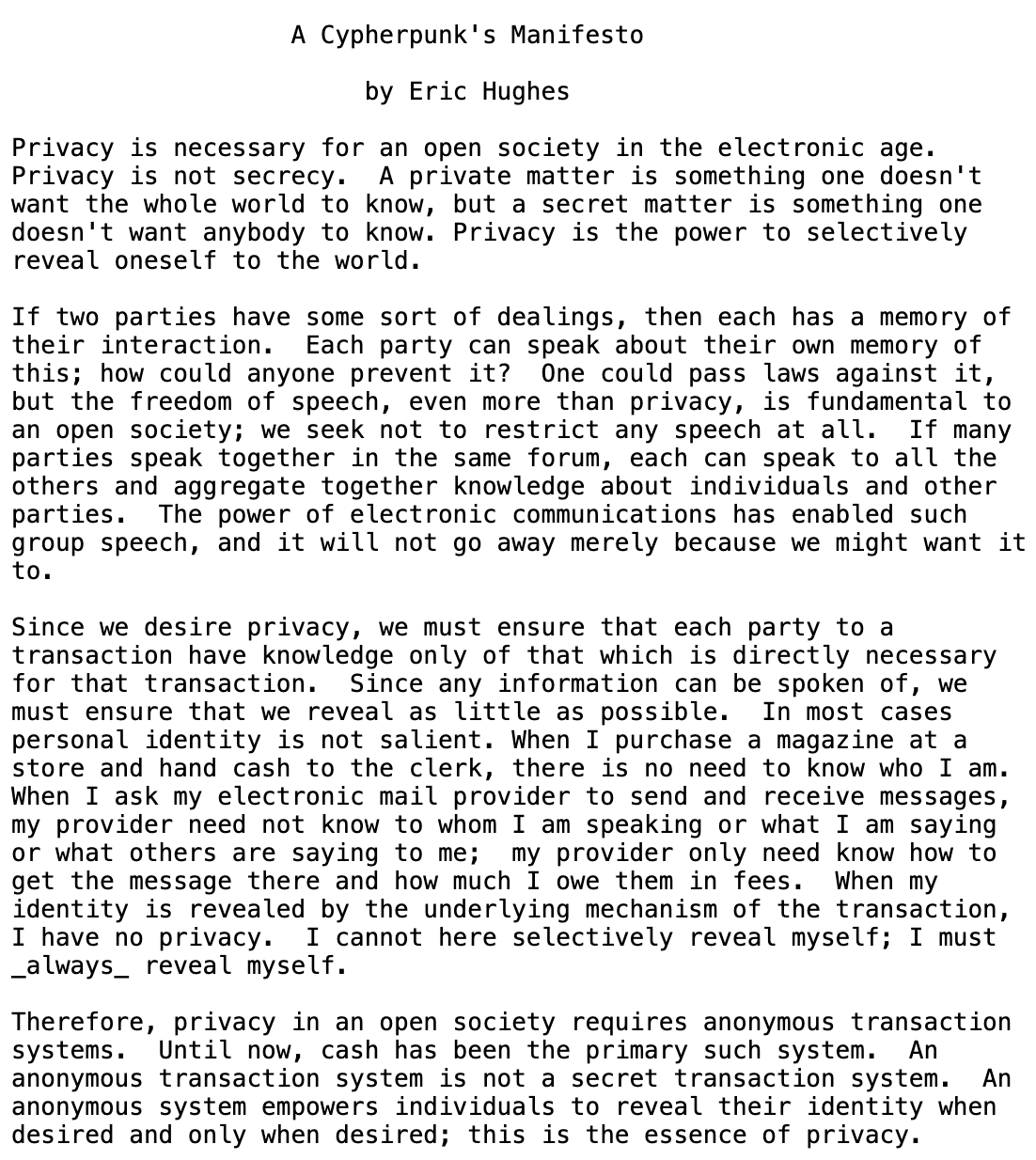
A Cypherpunk’s Manifesto is the document, written by Eric Hughes and distributed on the cypherpunk mailing list on March 9, 1993, that named the movement bitcoin would later emerge from. It runs nine paragraphs. It was signed simply Eric Hughes, hughes@soda.berkeley.edu. The manifesto’s central claim — that privacy in the electronic age cannot be granted by governments, corporations, or any other large institution, and must therefore be built by citizens themselves through code — is the philosophical scaffolding on which Satoshi Nakamoto’s whitepaper, fifteen years later, would rest.
Hughes was a mathematician and one of three founders of the cypherpunk movement, alongside Timothy May and John Gilmore. The three had been meeting monthly since late 1992 at Gilmore’s company in the San Francisco Bay Area. The group’s name was coined as a joke at one of their first meetings by the writer Jude Milhon, fusing cipher and cyberpunk. The mailing list that grew from those meetings would by 1994 carry seven hundred subscribers and become, for roughly a decade, the most concentrated venue in the world for technical and philosophical discussion of cryptography, anonymous systems, and digital cash. It is on that list that Wei Dai’s b-money, Adam Back’s Hashcash, Hal Finney’s reusable proofs of work, and many of the other technical antecedents of bitcoin were first proposed and debated.
The manifesto’s most-quoted line is the three-word declaration cypherpunks write code. The line is best read as a statement of method rather than identity. The cypherpunk thesis was that talking about privacy was insufficient; that legal arguments for privacy were structurally weaker than systems which made privacy violation technically infeasible; and that the appropriate response of a person who valued privacy was to build the systems themselves and release the source code freely. The manifesto continues: We don’t much care if you don’t approve of the software we write. We know that software can’t be destroyed and that a widely dispersed system can’t be shut down. The argument is that mathematics, once published, becomes ungovernable. This is the thesis bitcoin would later prove.
The relationship between the manifesto and bitcoin is one of direct lineage rather than coincidence. Satoshi Nakamoto announced bitcoin in October 2008 on a cryptography mailing list descended from cypherpunk culture. Hal Finney, the second person to run a bitcoin node, had been a cypherpunk since the early 1990s. Adam Back’s Hashcash, cited in the bitcoin whitepaper, had been a cypherpunk-list contribution. The architecture of bitcoin — pseudonymous, permissionless, freely-published code, deliberately ungovernable by any authority — is recognizably cypherpunk in design. Cypherpunks write code is, among other things, the line bitcoin made true.
The manifesto is short enough to read in five minutes. The Satoshi Nakamoto Institute hosts a clean copy. Bitcoiners cite it constantly and inconsistently, sometimes as scripture, sometimes as marketing. Both readings miss the document’s actual register, which is plain and exasperated and precise. Hughes was not writing a manifesto in the maximalist sense. He was writing instructions. The instructions said: write the code, publish the code, do not wait for permission. It remains, three decades later, the clearest statement of the philosophy from which bitcoin came.