 The Bitcoin Annotated
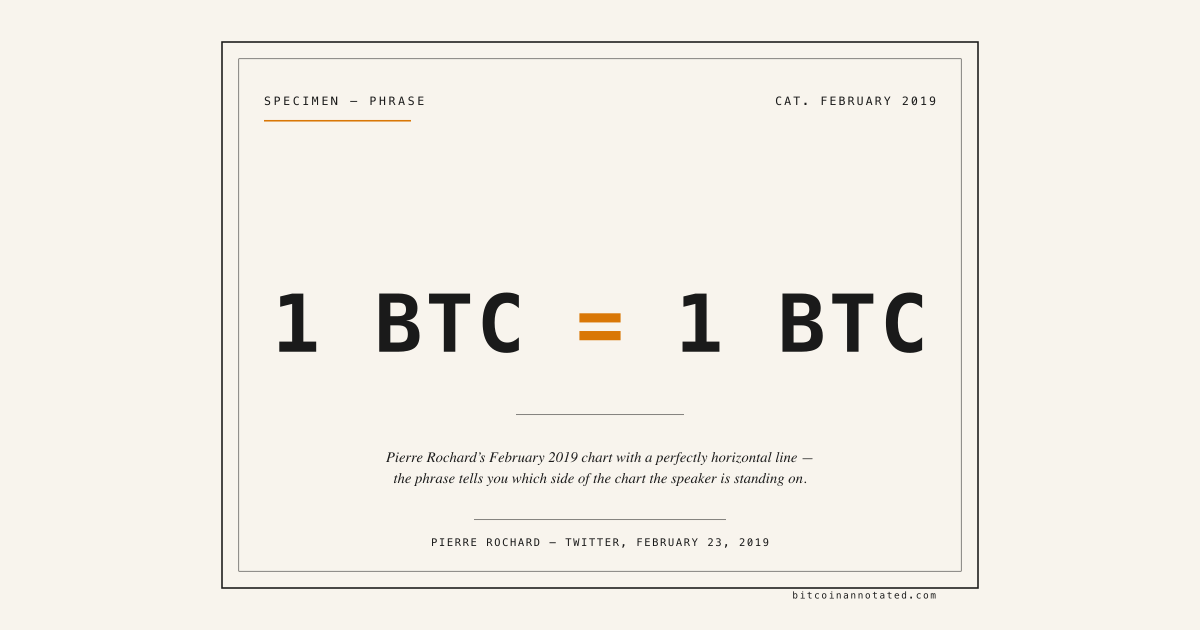
1 BTC = 1 BTC is the bitcoiner’s most patient response to the question of what bitcoin is worth. The phrase asserts a tautology — one bitcoin is equal to one bitcoin — and offers no further explanation, because the explanation is the tautology itself. The dollar price is volatile because the dollar is volatile; the bitcoin price is stable because the bitcoin is stable; the question of which way the relationship runs is the entire argument. The phrase is short by design. It functions as a refusal to participate in the framing of the question that prompted it.
The construction has a documented origin. On February 23, 2019, Pierre Rochard — a bitcoin developer and educator, then publishing under the Bitcoin Is Saving Twitter account, later vice president at Riot Platforms — posted a chart whose y-axis was labeled 1 BTC and whose x-axis was time. The line was perfectly horizontal. The chart depicted, with the formal apparatus of financial visualization, the claim that one bitcoin in 2013 equalled one bitcoin in 2019. Reactions divided. Several commenters argued the chart was meaningless, given that fewer bitcoins had been mined in 2013 than in 2019, and that the proper relationship would only be exact at the asymptote when all twenty-one million had been issued. Rochard responded that this was a feature rather than a bug. Samson Mow, the bitcoin-infrastructure executive, wrote that the chart depicted bitcoin as the only available stable unit of account in a world where the dollar denominator was being inflated away.
The argument the phrase compresses is sometimes called unit-bias. The claim is that pricing things in dollars naturalizes the dollar as a stable measuring stick when in fact the dollar’s purchasing power has declined steadily and substantially over the period bitcoin has existed. Pricing in bitcoin inverts this assumption. Asked whether bitcoin is up or down this year, the bitcoiner trained on 1 BTC = 1 BTC will answer: bitcoin is exactly where it was. It is the dollar that has moved. The reframing is not strictly correct in the short run — bitcoin’s purchasing power against goods and services has varied considerably — but it is consequential as a habit of mind. The phrase teaches the speaker to think in bitcoin first.
The phrase’s cultural prominence has tracked with bull markets. ForkLog noted in 2025 that across multiple linguistic variants of the phrase, search-trend peaks coincide with rallies in roughly two-thirds of cases and with sentiment reversals at potential breakouts in the rest. Bloomberg dedicated a feature in September 2022 to the phrase’s use as a coping mechanism during that year’s bear market — bitcoiners who had bought near the top responding to dollar-denominated losses by insisting they had not lost any bitcoin, only some dollars. The article was titled 1 BTC = 1 BTC: Crypto Looks for New Narrative as Plunge Goes On. The phrase was, as the article documented, the narrative.
What the phrase does, more than anything, is tell the reader where the speaker is standing. From within bitcoin, looking out, one bitcoin equals one bitcoin and the world’s prices fluctuate. From within the dollar, looking at bitcoin, the price is up or down on the day. The phrase is an invitation, in three characters and an equals sign, to switch which side of the chart the viewer is standing on. The bitcoiner has already switched. The phrase is, in this respect, a quiet kind of evangelism.