 The Bitcoin Annotated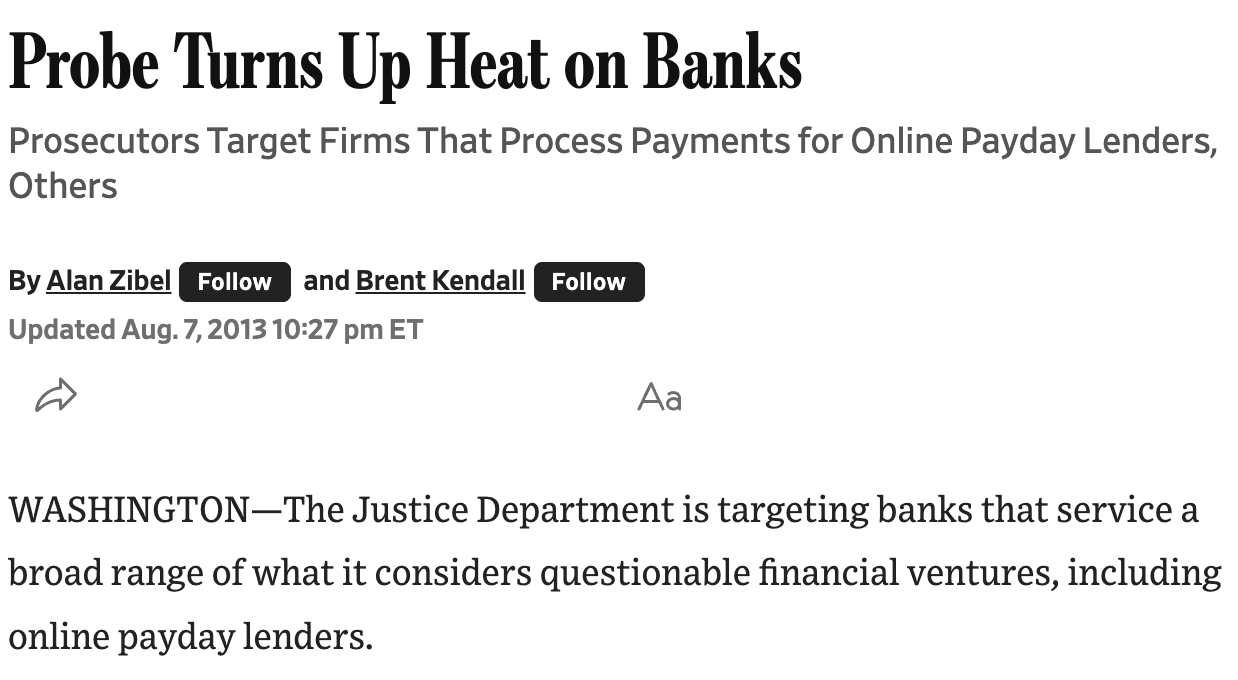
On August 8, 2013, the Wall Street Journal published a story by Alan Zibel and Brent Kendall titled Probe Turns Up Heat on Banks. The article disclosed, for the first time publicly, the existence of an Obama-era Department of Justice initiative that had been operating since 2012. The program had no formal name in the press until the Journal attached one to it: Operation Choke Point. An unnamed DOJ official, quoted in the piece, described the program as an effort to change the financial system to “choke off” fraudulent merchants “from the very air they need to survive.” The phrase, almost too convenient as a policy description, became the program’s identity.
The mechanism was specific. The Department of Justice and the Federal Deposit Insurance Corporation issued informal guidance to banks identifying certain customer industries as carrying elevated “reputational risk.” The list, distributed through FDIC supervisory channels, included thirty merchant categories: payday lenders, online pharmacies, firearms and ammunition dealers, telemarketers, sweepstakes, pornography, fireworks, As Seen on TV products, dating services, escort services, and — in versions of the list circulated through 2014 — virtual currency. The categories were not illegal. They were politically disfavored. Banks that continued serving customers in these categories faced enhanced supervisory scrutiny, threatened CAMELS-rating downgrades, and the implicit suggestion that their next examination would be unpleasant. Most banks responded as expected. Account closures followed. Targeted businesses found themselves unable to process payments, retain payroll services, or access basic financial infrastructure.
Bitcoin businesses were swept into the program as collateral damage rather than as the primary target. Bitcoin in 2013 was a small industry: Mt. Gox dominated trading, Coinbase was a year old, the Silk Road takedown was still two months away. The bitcoin economy did not yet have political enemies sophisticated enough to target it directly. What it had instead was the misfortune of being categorized as “high risk” alongside payday lenders, and of using the same payment processors that the program was designed to pressure. Exchanges experienced bank account closures with no stated reason. Customers experienced ACH transfers reversed. Bitcoin businesses with no fraudulent activity, no AML failures, and no consumer complaints found their banking relationships terminated.
The program faced sustained pushback. The American Bankers Association objected. Frank Keating, a former DOJ official under Reagan, wrote that Choke Point “had more in common with a purge of ideological foes than a regulatory enforcement action.” William Isaac, former chairman of the FDIC, called it “way out of control.” The House Oversight Committee, in a May 2014 staff report, concluded that the program represented an “inappropriate exercise” of DOJ legal authorities under FIRREA Section 951 and recommended it be dismantled. The Trump administration’s DOJ formally ended Operation Choke Point in August 2017. The FDIC settled multiple lawsuits, promised additional training for examiners, and committed to ceasing the issuance of “informal” or “unwritten” suggestions to banks. The merchant-category list was revised. The program, as a named initiative, ended.
What did not end was the template. Operation Choke Point established that federal regulators could pressure private banks to deny services to legal businesses, without rulemaking, without due process, without any public list of targeted parties, through informal guidance and supervisory threats. The mechanism survived the program. The bitcoin community of 2013 absorbed this as foundational knowledge: that access to the banking system was conditional on political tolerance, that the conditional was unwritten, and that there was no due-process appeal. The institutional skepticism that runs through every later artifact in the catalog traces directly to this period: not your keys, not your coins, the maxi-libertarian distrust of regulators, the founding-era suspicion that bitcoin’s enemies would come through banking access rather than through protocol attack.
The program ended. The playbook remained.