 The Bitcoin Annotated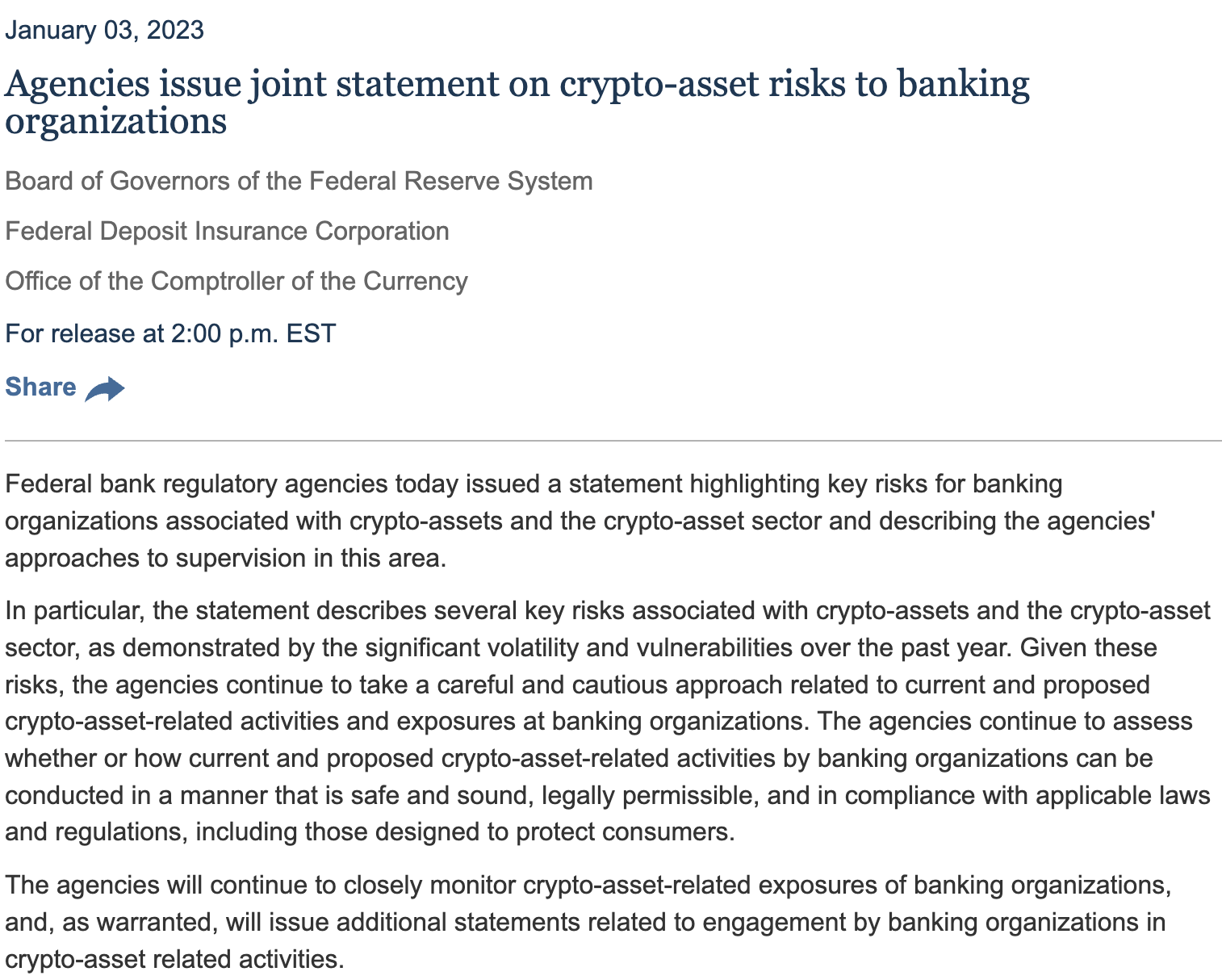
The name was Nic Carter’s. In a February 2023 essay for Pirate Wires, Carter — a venture investor at Castle Island Ventures — argued that the events unfolding around bitcoin and the broader digital asset industry constituted a coordinated regulatory effort to cut crypto businesses off from the U.S. banking system. He called it Operation Choke Point 2.0. The essay traveled. The name traveled faster. By the end of 2023 the term was in House Financial Services Committee testimony, Wall Street Journal editorials, and federal-agency denials. The federal agencies maintained, throughout, that no coordinated effort existed. Subsequent FOIA disclosures established that the agencies were lying.
The events the name described were specific. On January 3, 2023, the Federal Reserve, the FDIC, and the Office of the Comptroller of the Currency issued the Joint Statement on Crypto-Asset Risks to Banking Organizations, the first coordinated public expression of regulatory hostility toward crypto banking. In the months that followed: Silvergate Bank, the largest U.S. bank serving crypto clients, voluntarily liquidated in March 2023 after losing access to Federal Home Loan Bank funding. Signature Bank, where roughly thirty percent of deposits came from crypto firms, was seized by the New York Department of Financial Services on March 12, 2023, in what became the third-largest bank failure in American history; the FDIC subsequently arranged a sale that explicitly excluded Signature’s digital-asset banking business. Custodia Bank, a Wyoming special-purpose depository institution founded by Caitlin Long for the express purpose of safely custodying digital assets, was denied a Federal Reserve master account in January 2023 after a multi-year application process. Coinbase, Kraken, and other crypto firms reported that their banking partners were terminating relationships without explanation.
The agencies denied any coordinated effort. The denials were undermined by FOIA releases. In 2023 and 2024, History Associates Inc., representing Coinbase, obtained a series of FDIC “pause letters” instructing supervised banks to “respectfully” cease all crypto-related activities pending further review. The letters had not been publicly disclosed. The FDIC had told Congress, in sworn testimony, that no such instructions existed. Marc Andreessen, in a November 2024 Joe Rogan podcast appearance, brought the term Operation Choke Point 2.0 to a mainstream audience, calling debanking a “privatized sanctions regime.” The episode was, by some measures, the moment the issue moved from industry grievance to political consequence.
The political resolution arrived through the 2024 election. The incoming Trump administration named David Sacks as the first White House “Crypto Czar.” On August 7, 2025, President Trump signed an executive order directing federal agencies to audit prior debanking incidents, ending the use of “reputational risk” as a supervisory criterion, and providing for sanctions against institutions that had unlawfully denied services. The order was the formal repudiation. The House Financial Services Committee, in a November 2025 report, concluded that the Biden administration “reinvented the Obama Administration regulators’ Operation Choke Point 1.0 playbook” and applied it to the digital asset ecosystem. The catalog notes the bipartisan symmetry as a matter of factual accuracy rather than partisan claim: the original playbook was authored by one administration, the second-version application was executed by another, and the legal mechanism — informal regulatory guidance leveraging supervisory authority to compel private actors — survived both.
What the bitcoin community took from the experience is harder to summarize because it is still being absorbed. Caitlin Long has continued to argue, through 2025 and 2026, that the program is “not dead yet,” that the supervisory tools remain in place, that the personnel responsible remain in their positions, and that the absence of a named program is not the same as the absence of the practice. The catalog records this position as a documented public claim and notes that it has not been refuted. The episode confirmed, for a generation of bitcoin participants who had not lived through Operation Choke Point 1.0, that the institutional skepticism inherited from the earlier era had been correct. Banking access was political. The political control was unwritten, and the remediation electoral.
The first program was named by a journalist, the second by a venture capitalist. Both names were accurate.