 The Bitcoin Annotated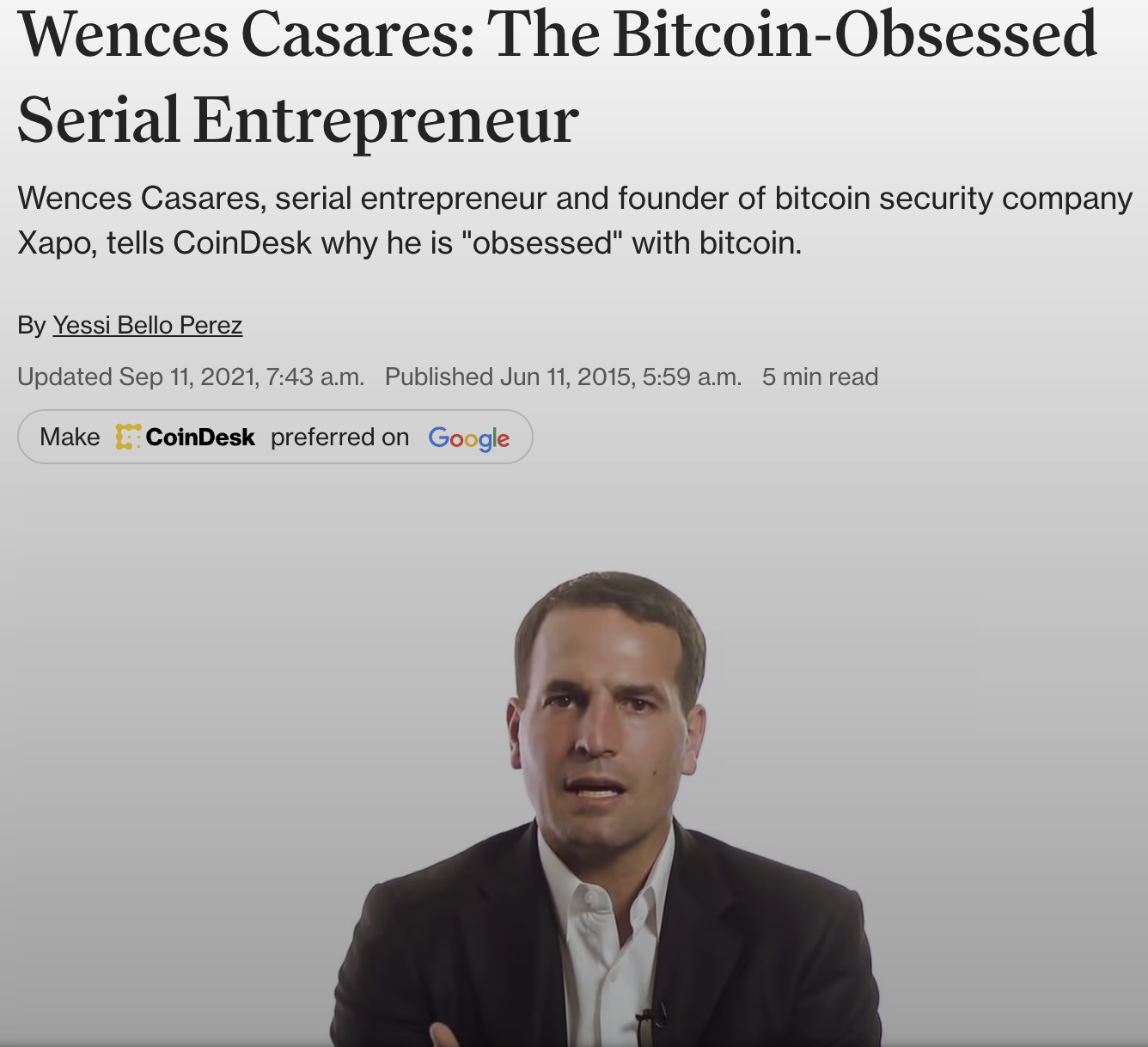
The artifact is not the man. The artifact is the social transmission. Between approximately summer 2013 and the spring of 2014, the bitcoin community of Silicon Valley shifted from a small group of cypherpunks, libertarians, and early developers into something else: a roster of named billionaires and venture partners who had personally bought bitcoin, who knew each other, and who had each been convinced by the same Argentine entrepreneur over private dinners. The transmission has a name. Reid Hoffman gave it one in 2014. He called Wences Casares Patient Zero.
Wenceslao Casares was born in Patagonia in 1974 and built his career across four currencies and three failed governments. By 2013, when he settled in Palo Alto and began telling Silicon Valley about bitcoin, he had already founded an Argentine internet service provider, an online stockbroker, a video game company, and a digital bank. He had lived through Argentina’s hyperinflation. He had watched his family’s savings evaporate twice. The conviction he brought to bitcoin was not theoretical. He had needed bitcoin before bitcoin existed, and he recognized it on arrival.
The mechanism of transmission was unremarkable. Casares had dinners. The dinners were in Palo Alto, in San Francisco, in Woodside, occasionally in New York, and at the Allen and Company conference in Sun Valley. The participants were the people Casares already knew through the Argentine entrepreneurial network and the people they introduced him to. The argument he made was the same argument every time: bitcoin was not yet a payment system, and might never be one in the way the bank research reports were imagining; bitcoin was a globally available, politically neutral asset, more like gold than like a credit card; one should buy a small amount, hold it for at least five years, and ignore it. The ask was modest. One percent of net worth, or less. The ask scaled with the audience.
Reid Hoffman, the LinkedIn co-founder and Greylock partner who had earlier helped build PayPal, sought out Casares in summer 2013 after several intermediaries had mentioned him. The two met. Hoffman, by his own account, was skeptical of the credit-card-replacement framing that dominated the early bitcoin pitch. Casares agreed with him on that point and offered the gold-not-cash framing instead. The argument worked. Hoffman bought bitcoin. He also asked his money manager, Divesh Makan (one of the Valley’s most connected wealth advisors), to do the same. The signal traveled. By late 2013, at a dinner Hoffman attended with Casares and PayPal CEO David Marcus, the conversation had shifted from whether to buy to how much. The follow-up at Woodside Bakery in January 2014 was no longer about persuasion. It was about logistics.
The roster Casares ultimately reached, by his own attribution and the attribution of others, included Bill Gates, Reid Hoffman, Chamath Palihapitiya, Bill Miller, Mike Novogratz, Pete Briger, and the long tail of Silicon Valley and Wall Street figures who took dinners with him through 2014 and 2015. He founded Xapo in 2014 to provide bitcoin custody for this audience specifically: wealthy clients who wanted exposure but not key management. Greylock, with Hoffman leading, invested twenty million dollars. At its peak, Xapo custodied roughly ten billion dollars in bitcoin in underground vaults across five continents. In 2018, Casares spoke on the cryptocurrency panel at Allen and Company’s Sun Valley conference, the most exclusive media-and-tech gathering in the world, and predicted that bitcoin could reach one million dollars per coin within ten years.
What the transmission produced, beyond the individuals it converted, was a class shift. Bitcoin in 2012 was cypherpunks, libertarians, Austrian economists, and the residual community of Mt. Gox traders. Bitcoin in 2014 had Reid Hoffman. The shift had cultural consequences that ripple through every later artifact in the catalog: the legitimization of bitcoin in venture capital, the institutional respectability that allowed the Coinbase IPO and the Tesla treasury and the BlackRock spot ETF approval to become thinkable, the slow conversion of bitcoin from outsider technology to billionaire-class asset. The transmission did not invent any of that. It made it possible.
Patient Zero, in epidemiology, is the index case: the first known infection of a viral contagion. The metaphor is Hoffman’s, and he meant it as praise. Bitcoin had been spreading through cypherpunk and libertarian networks for four years before it reached Silicon Valley’s executive class. It needed a vector that the executive class would receive. Casares was that vector. He spoke their language, kept his predictions modest, asked for small allocations, and was willing to have the same conversation across hundreds of dinners over five years.