 The Bitcoin Annotated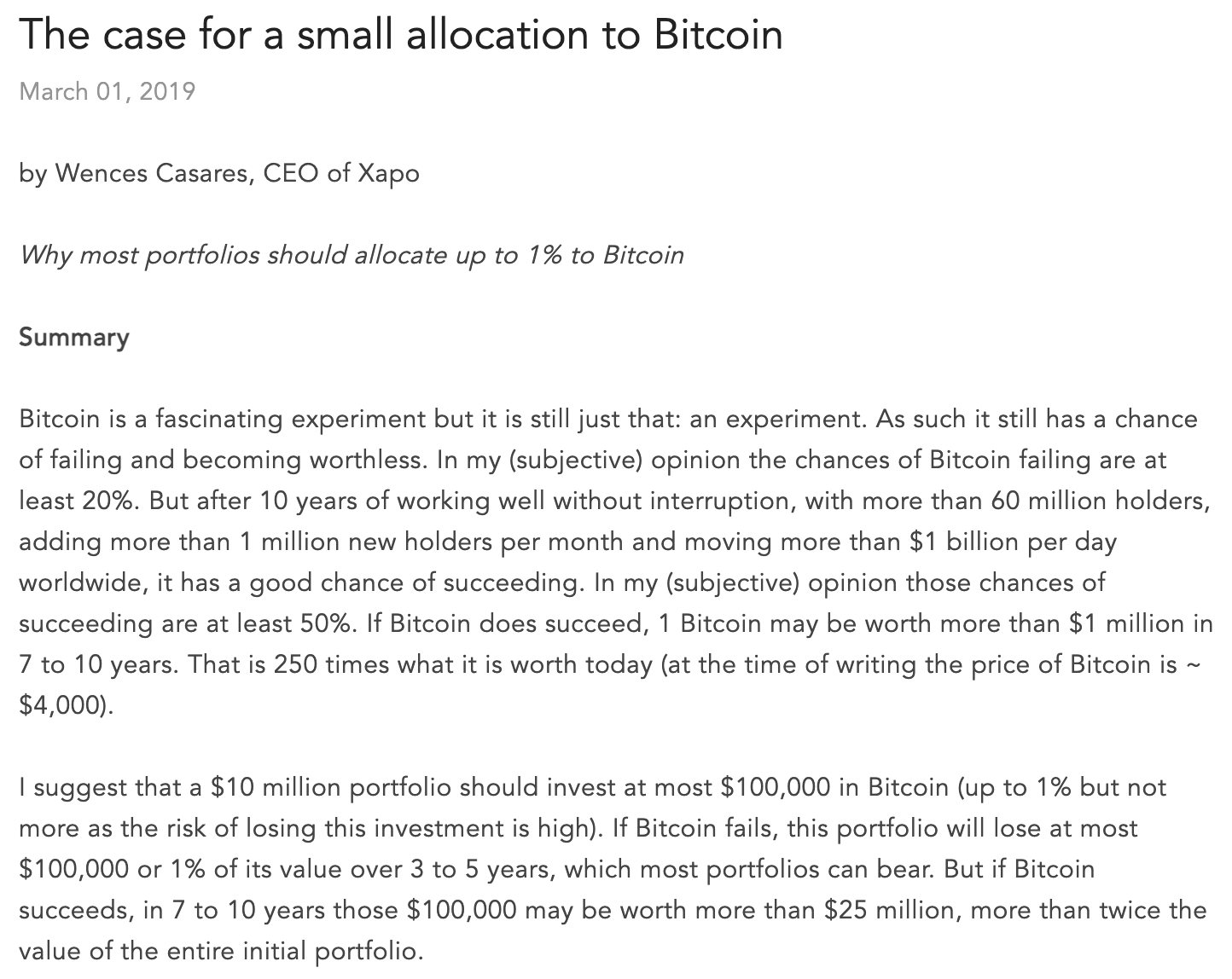
Wences Casares grew up in Patagonia. His parents were sheep ranchers. By his account, he watched his family lose their savings three times before he was an adult — first to devaluation, then to hyperinflation, finally to a government bank-deposit confiscation. The essay opens with this story. It is not a finance argument that begins with finance. It is a finance argument that begins with what finance is for.
By the time Casares wrote The Case for a Small Allocation to Bitcoin in March 2019, he was the CEO of Xapo, one of the earliest serious bitcoin custody businesses, and he sat on the board of PayPal. He was, by then, the bitcoiner most likely to be the bitcoiner Wall Street had actually met. The essay was not posted on a bitcoin-native publication. It circulated as a PDF, then as an HTML mirror on a half-dozen finance and bitcoin blogs. It was emailed by allocators to other allocators. It was handed to family-office principals who had been ignoring bitcoin for a decade and who needed a document, written by someone they recognized as one of their own, that explained why they should reconsider.
The argument was structurally conservative. Bitcoin might fail; Casares put the probability at twenty percent or higher. A portfolio should therefore not allocate more than one percent. But a portfolio should not allocate less than one percent either, because the asymmetric upside if bitcoin succeeded was large enough that zero exposure was itself a portfolio decision, not a neutral position. The exact framing: a ten-million-dollar portfolio should allocate up to one hundred thousand dollars to bitcoin. If bitcoin failed, the portfolio absorbed a one percent loss it could afford. If bitcoin succeeded — which Casares, in the essay, defined as roughly one bitcoin reaching one million dollars within seven to ten years — that hundred thousand became more than twenty-five million. Not allocating, the essay argued, was the irresponsible position.
The numbers were aggressive but the reasoning was unimpeachable on its own terms. The essay treated bitcoin as a small probability of an enormous outcome and worked the math accordingly. It sized rather than promised, and allocated rather than preached. This was the essay’s contribution to the genre. Other bitcoin advocacy in 2019 was either evangelical or technical. Casares wrote the document an institutional allocator was professionally permitted to read.
The essay is the reason MicroStrategy’s August 2020 treasury allocation — and Tesla’s, and Square’s, and the wave of corporate and family-office allocations that followed — had a precedent that allocation committees could cite. It is not the foundational text of institutional bitcoin adoption; The Bitcoin Standard and other earlier theoretical work had already argued the case. It is the document that translated those arguments into a framework an allocator could submit to a risk committee. The catalog includes it for the same reason it includes the Antonopoulos books: not because it was the most original work of its era, but because it was the document a particular kind of person kept handing to a particular kind of person, and the conversion script worked.