 The Bitcoin Annotated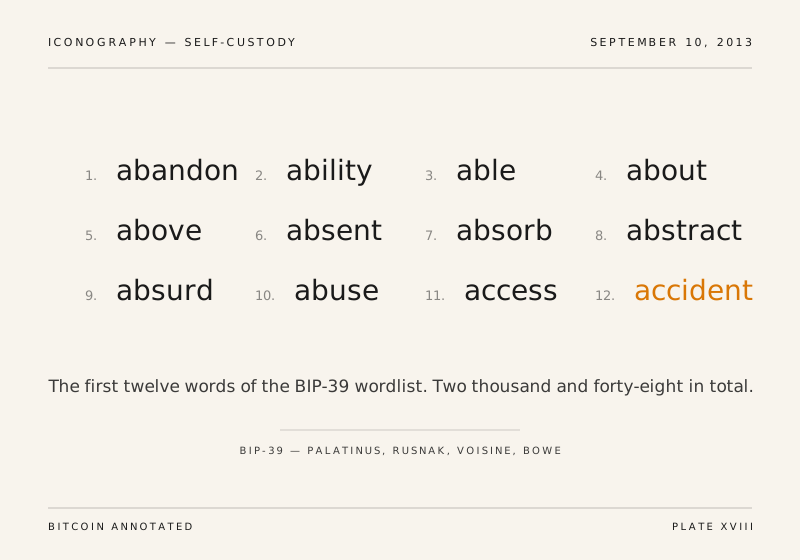
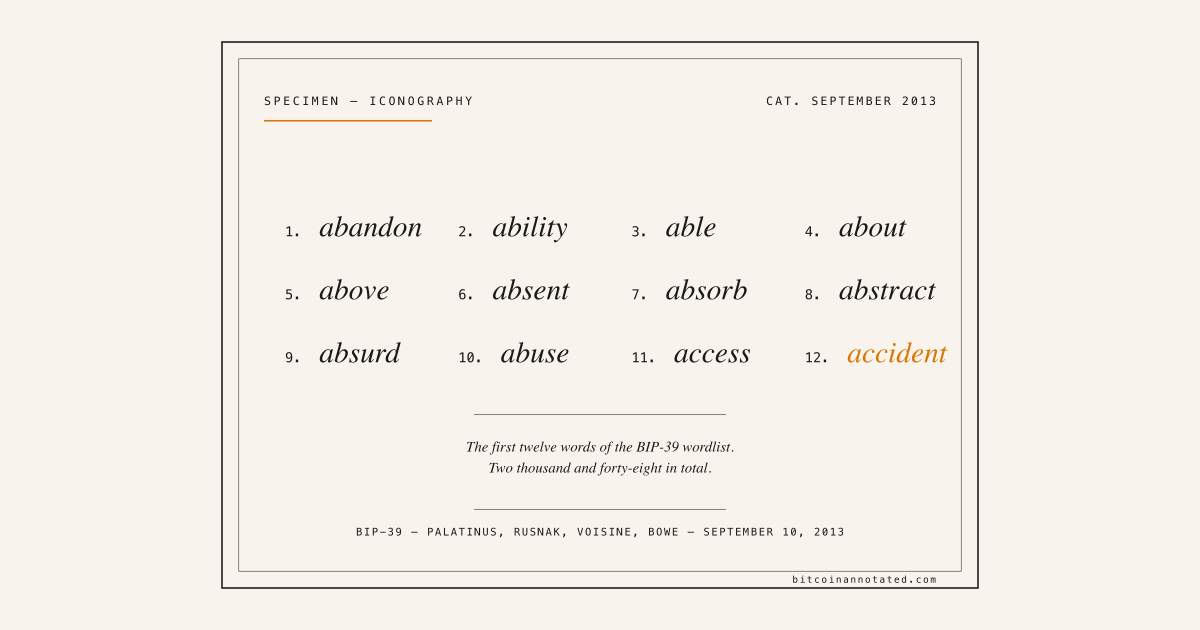
Every bitcoiner has stared at one. Twelve words, sometimes twenty-four, written by hand on a piece of paper or stamped into a steel plate. The words come from a list of 2,048, chosen for low typo risk and minimal overlap. Abandon ability able about above absent absorb abstract absurd abuse access accident. Those are the first twelve, in order. They mean nothing in sequence; the sequence is the point.
The technical document underneath is BIP-39 — Bitcoin Improvement Proposal 39, Mnemonic code for generating deterministic keys — assigned on September 10, 2013, authored by Marek Palatinus and Pavol Rusnak of SatoshiLabs (the company that would build Trezor) along with Aaron Voisine and Sean Bowe. The proposal’s mechanics are simple: a random 128-bit (or 256-bit) entropy seed is converted into a sequence of words drawn from a fixed wordlist, with a checksum at the end. The words can be reconstituted into the seed; the seed can derive any number of bitcoin private keys. Twelve memorable words replaced unmemorable strings of hexadecimal. Self-custody, which had been a thing only programmers could do reliably, became something anyone could do, provided they did not lose the words.
The cultural artifact is not the BIP. The cultural artifact is the words on the page. The seed phrase is the most distinctive physical object bitcoin produced, in the sense that no other technology in the protocol’s first fifteen years generated a comparable physical-world residue. Hardware wallets are objects, but the words are the object. The words are what gets stamped into steel — Cryptosteel, Blockplate, the Coldcard’s seed XOR cards — and stored in safes, buried in yards, split across geographic locations using Shamir’s secret sharing. The words are what gets photographed against wood-grain desks for the cold-storage-setup-photo genre. They are what gets read aloud in the cautionary tale every bitcoiner tells about the friend who lost their phrase, or the friend who stored it in a screenshot.
The discipline that surrounds the artifact is its own cultural product. Never store digitally. Never type into a website. Never photograph. Never share, even with family, until you’ve decided on inheritance plan. These rules are not in BIP-39. They emerged in the years after, as the cohort that adopted self-custody learned, mostly through other people’s losses, what the words actually demanded. The seed phrase is the artifact through which bitcoin teaches its users what sovereignty costs. It is also the artifact through which bitcoin asks them to take it.
The catalog treats the seed phrase as iconography rather than as a document because the document, BIP-39, is the technical implementation, while the words on the page are the cultural object. The protocol generates the entropy. The wordlist names it. The bitcoiner copies it down by hand, because that is the rule, and stares at twelve ordinary English words that, in this exact order, are a key to a fortune or to nothing at all.