 The Bitcoin Annotated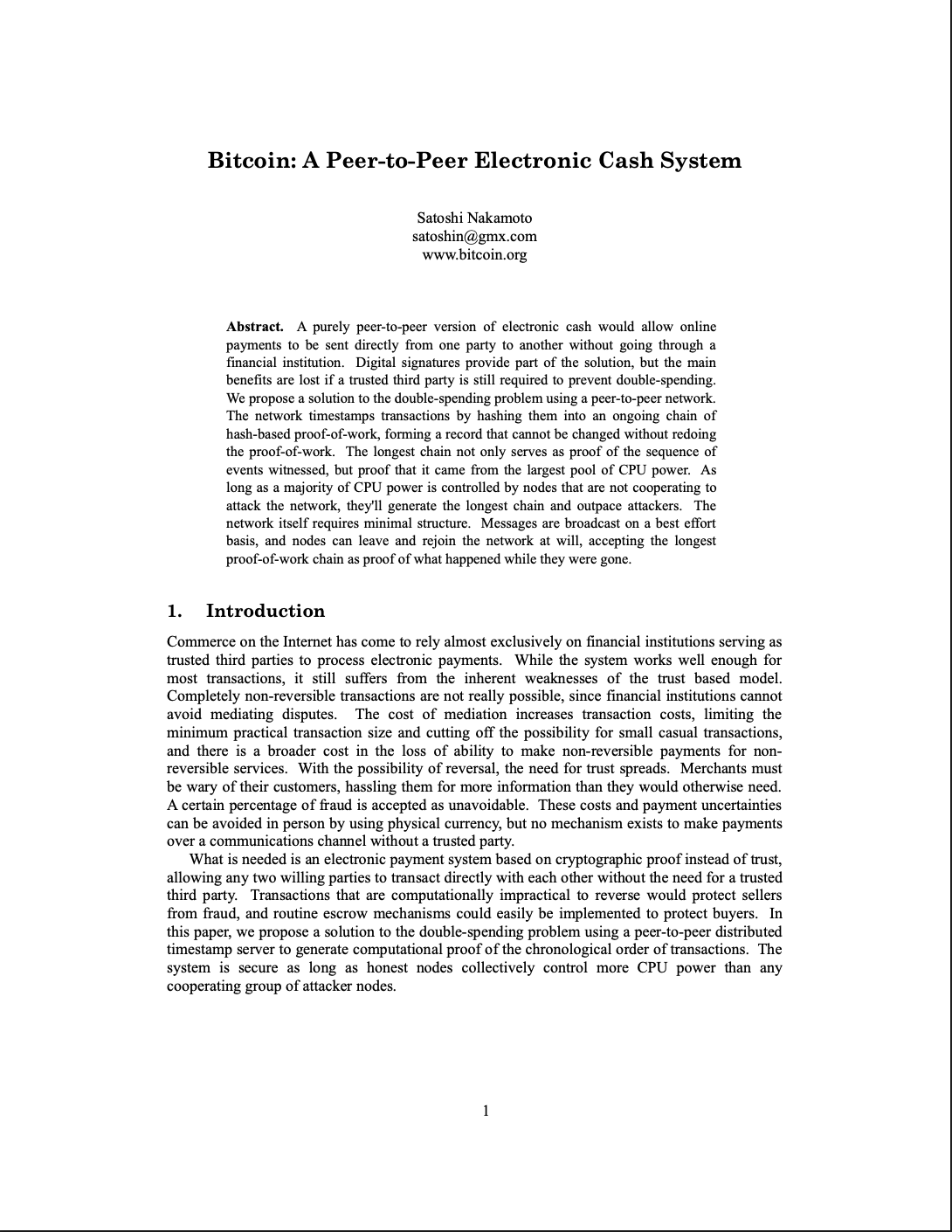
On the afternoon of October 31, 2008 (Halloween, 2:10pm Eastern), a person calling themselves Satoshi Nakamoto sent an email to a low-traffic mailing list run out of metzdowd.com. The list was a haunt for cypherpunks and cryptographers, the survivors of a decades-long argument about whether private digital money was possible at all. The subject line read: “Bitcoin P2P e-cash paper.” The first line announced a new electronic cash system, fully peer-to-peer, with no trusted third party. Attached was a nine-page PDF.
The paper was titled Bitcoin: A Peer-to-Peer Electronic Cash System. It had been authored in OpenOffice.org Writer 2.4. The bitcoin.org domain had been registered ten weeks earlier, on August 18. The email came from satoshi@vistomail.com. The timing was conspicuous: the United States Congress had passed the $700 billion Emergency Economic Stabilization Act four weeks prior. The whitepaper does not mention the bailout. It did not need to.
The paper itself was technical, dense, and short. It described a system in which a chain of digital signatures, secured by computational work, could establish a public ledger of transactions without requiring trust in any single party. The mechanism — proof-of-work, a Merkle tree of transaction hashes, a longest-chain rule for resolving disputes — synthesized ideas that had been circulating in cryptographic literature for two decades. Adam Back’s Hashcash. Wei Dai’s b-money. Hal Finney’s Reusable Proof-of-Work. Nick Szabo’s bit gold. Satoshi cited some of them. Most of the assembly, however, was new.
The mailing list’s first reactions were skeptical. James Donald, a regular, replied that the proposal did not appear to scale. Others raised technical objections about double-spending, network synchronization, and the soundness of the incentive design. Hal Finney was the first to respond constructively. Sixty-four days later, on January 3, 2009, the network would be live.
The whitepaper has since been translated into more than forty languages, printed onto t-shirts, etched onto metal plates, and read aloud at weddings. Its first sentence, a purely peer-to-peer version of electronic cash would allow online payments to be sent directly from one party to another without the burdens of going through a financial institution, is among the most-quoted sentences in modern computing. It remains, sixteen years on, the founding document of an asset class, a software protocol, and a worldview. It was published anonymously, on a holiday, to an audience of perhaps a few hundred people, most of whom did not write back.